10/29/09

Sukiyaki and Holiday White Wine Sale

This recipe should be called "Japanese-American Style Sukiyaki" because it is stronger and deeper in flavor than the traditional style served in restaurants. My dad was born in Japan and I loved to watch him make it. Though he was a "issei" or first generation Japanese-American, like many immigrants, his dishes had a "nikkei" flavor to them--meaning that the traditional recipes had changed to reflect American tastes and available ingredients. At New Year's parties, mochi making gatherings, picnics and Buddhist Temple suppers, and at home, I remember cucumber with bay shrimp and fennel seed, teriyaki green beans, potato salad with chiso and other recipes common to the community but never found in a restaurant. I've thought that Japanese-American style recipes would create an interesting and unique cookbook, but a Google search yielded just a couple of links for "Japanese American cookbook". The first for Avenue Food has a post by Sarah Kiino that describes recipes from Japanese-American church cookbooks: "Of course, many of the "Japanese" recipes are about as Japanese as General Tso's Chicken is Chinese. They have Japanese elements, sure, but were created by Japanese Americans, often several generations removed from the homeland." From the National Association of Japanese Canadians forum: "there is a Japanese American culture and that culture is based not on exact rules, but on the recollections of what our Issei parents and grandparents interpreted of their homeland into their lives in America. Food products like they had back home were not available and so they tried to get something that was similar (like using yams in tempura instead of kabocha)." Only a few cookbooks are mentioned, and the National Japanese American Historical Society cookbook is no longer available on their site. Like the small Japantown in Denver, which used to house mom-and-pop groceries, restaurants and shops clustered around the Buddhist Temple, the cultural heritage of Japanese-American food may disappear, assimilated and dispersed into the mainstream.
Though Sukiyaki contains beef, this is one example of when a clean, crisp white wine pairs better than a red wine which would conflict with the deep flavors of soy sauce, ginger and sugar.
SUKIYAKI:
3 Tbsp. sesame oil
1 cup thinly sliced onion
3 cloves garlic, minced
3 Tbsp. ginger, minced
1 lb. sliced steak (if you have an Asian market--use the very thinly sliced sukiyaki beef, otherwise slice filet mignon as thin as you can, or use lean ground beef made into small meatballs, see below* for more notes)
1/4 Mirin (Japanese cooking sake)
1 cup soy sauce
1/2 cup loosely packed brown sugar
2 cups vegetables, cut into bite size, such as bean sprouts, green beans, zucchini, broccoli, green pepper, baby corn, water chestnuts
2 cups coarsely chopped napa cabbage or bok choy
1 cake of tofu, cut into 1" cubes
1. In a wide, deep pan, cook the ginger, garlic and onion in the oil over medium heat, stirring occasionally. When the onion is translucent, add the beef, browning on all sides. Then add the soy sauce, Mirin and sugar and stir gently to mix. Add the cut vegetables and stir, then cover the top of the beef and vegetable mixture with a "lid" of the napa cabbage or bok choy.
2. Turn the heat to low and simmer for approximately half an hour--until the vegetables are nearly cooked. Then stir the top layer of bok choy or cabbage in with the rest of the ingredients and add the tofu cubes. Cook another five minutes, stirring carefully so the tofu doesn't break apart (turning the ingredients with a wide spatula works well). Serve with hot Japanese rice and the 2007 Greenwood White Riesling. Serves 4. Leftovers can be piled onto a bowl of the leftover rice and reheated in the microwave to make a sukiyaki "donburi" or rice bowl. Top with kizami (red pickled grated ginger).
*Note on beef: if you can buy prepared Japanese sukiyaki beef, this is best. This can be found in most Asian markets and is made by freezing the steak, then using a machine to slice it very thin. If you have to slice your own steak, use filet mignon if you can afford it because less tender types of steak will become tough in the cooking. Another alternative that's easier on the budget is to use lean ground beef, shaped into small meatballs.

The 2007 Greenwood White Riesling is one of six white wines in this week's Online Grapevine special. The Online Grapevine changes each week, but always offers FREE wine shipping in the continental US. (sorry, Alaska and Hawaii)

10/21/09

Thanksgiving Wine, Menu Planning and Minty Gazpacho


It's not too early for those of us who love to cook to start planning our Thanksgiving menu. It's bound to be a heavy feast with a lot of rich food, so starting with a light, lo-cal soup sounds perfect to me. It's chilled and crisp with enough flavor to pique to the taste buds' interest but won't fill you up before the main course arrives. Plus, you can make this a day or two beforehand, cutting down on the time in the kitchen on the big day. I'm always looking for an excuse to chop vegetables with my chef's knife (see Aug.10 post); but if you don't have the "joy of chopping", this soup is quickly prepared in the food processor. Historians believe gazpacho was created during the Roman occupation of southern Spain--no blenders then! Originally crushed in a dornillo or large wood bowl in the fields, the soup was a common lunch for the agricultural workers. The addition of tomato to the gazpacho originated with Christopher Columbus who initiated the era of exchange of plants and animals (and unfortunately, diseases) between the Old World and the New. Imagine if the exchange had never happened. Italian cuisine would be without tomatoes and the Swiss would be bereft of chocolate! In Spain, there are regional variations of gazpacho, some without tomato, some adding almonds, or cumin. I made this version with mint from the garden. Instead of adding bread to the soup, as is common with Spanish recipes, I toasted the bread Italian style with olive oil and Parmesan for crunchy croutons.
MINTY GAZPACHO WITH HERBED WHOLE GRAIN CROUTONS:
4 medium very ripe tomatoes
1 cucumber
1/2 green bell pepper
3 garlic cloves
1/2 small sweet white or red onion
2 tsp. white vinegar
9 Tbsp. olive oil approximately (5 for soup, around 4 for the croutons)
1 tsp. lemon juice
2 tsp. minced mint plus one sprig for each serving as garnish
2 Tbsp. minced cilantro
1 tsp. salt
1/8 tsp. black pepper
2 slices whole grain bread, 2 day old is best
3 Tbsp. grated Parmesan
2 tsp. fines herbes (purchased in spice section or made from recipe below)
Boil enough water to submerge tomatoes, when it boils, add the tomatoes and cook a couple of minutes or just until the skin splits. Remove and cool, then peel off the skins. Put the tomatoes in a flat bowl and mash thoroughly with a potato masher (or process in food processor). Peel the cucumber and cut in half lengthwise and scoop out the seeds. Mince the cucumber, bell pepper, onion and garlic finely by hand or with food processor. Add to the tomatoes along with the oil, vinegar, lemon juice, salt, pepper, minced cilantro and onion. Mix well and chill (at least an hour). Cut the crusts off the bread, toast until dry, then remove and brush with olive oil, sprinkle with cheese and fines herbes then toast until golden brown. Cut them into small croutons about 1" square. To serve, put 3/4 to 1 cup of gazpacho in a small bowl (this recipe makes 4 cups) and garnish with croutons and a sprig of mint. Refreshing with a crisp glass of the 2006 RaDog Dry Gewurztraminer.
This week's Online Grapevine wine discount special is four perfect Thanksgiving wines: RECIPE FOR FINES HERBES:
Simple! Mix equal parts chopped chives, chervil, parsley and tarragon and use for sprinkling on salads, cooked eggs, soups and croutons.

10/15/09

Chicken Pot Pies and Half Price Wine

When the weather turns colder, there's a temporary sense of loss and a lack of energy. Chinese philosophy would ascribe it to the seasonal movement of chi. For me, it is the realization that the hot, lazy days of summer are over. No longer can doors and windows be flung wide open letting in the brilliant sun and the air thick and heavy with the scent of growing things. No more watering vegetables and searching for the bright red of tomatoes and strawberries among the deep green foliage, eating them hot and juicy right out of the garden. I have a sadness to see long days shorten. But life turns inward, towards hot cups of tea by the fire and the preparation for the holidays. I enjoy the fellowship of the holidays, sharing food and conversation with friends and family but there is a sense of dread, too, mostly centered around gift giving. I hate shopping! So, working for a wine company has helped enormously as I increasingly give wine at the holidays (sometimes with jars of homemade jam, tins of cookies or bundles of sage from the garden). Those of us in Southern California are fortunate to be within driving distance of the Wine Warehouse sales at Touring & Tasting. I stocked up with $58 Cabernet Sauvignon for $25 a bottle and $26 Whites for $13 at the last one, so I'm set this year! For those who are too far for the Santa Barbara wine events, this week's special would make a great gift. It's a half price sale on a wine sampler that's already a great deal at full price--with free shipping to boot! Send the gift of wine this holiday--no parking hassles, no crowds, no fuss!
This week's recipe is perfect for the colder weather. Enjoy with a bottle of 2008 Saucelito Canyon Central Coast Sauvignon Blanc from the Wine Cellar.
INDIVIDUAL CHICKEN POT PIES:
1 14 oz. can of chicken broth (almost 2 cups)
1 lb. chicken meat, cut into bite-sized pieces
1 cup peeled and diced potato (about two small potatoes)
1/2 cup finely chopped onion
1 cup peeled and diced carrots (two large)
1 cup frozen peas
1 bay leaf
5 Tbsp. butter
1/2 cup flour
1 cup half and half
1 cup milk
1 tsp. poultry seasoning (thyme, sage, marjoram, rosemary, nutmeg)
1 tsp salt
1/4 tsp white pepper
2 frozen deep dish pie crusts
Let the pie crusts come to room temperature. Preheat oven to 400°F. Bring broth and bay leaf to a boil then add the chicken, potato and carrots. Cook 5 minutes or until the carrots are softened but not mushy. Remove the bay leaf and turn off the heat. In the meantime, cook the onion in butter in a saucepan (at least a quart size) over low heat until the onion is translucent, stirring occasionally. Whisk in the flour until well mixed. Using a slotted spoon or sieve to keep the chicken and vegetable back, carefully pour in a third of the broth and whisk until well mixed. Continue with the next two thirds, whisking after every addition. Then add the half and half, milk, poultry seasoning, salt and pepper. Whisk well and cook over medium heat for a few minutes until the mixtue has thickened. Add the chicken and vegetables, adjust seasonings, then ladle into soup bowls. Turn the pie crusts over onto a lightly floured cutting board and pat it flat with your hands. Cut the dough into wide strips. Weave the strips over the tops of the bowls and trim the ends 1/2" below the outside rim. Roll leftover dough in long "snakes" and put around the edges of the pies, pinching the dough around the edges to seal the edges. Crimp with your fingers or a fork. Let some spaces remain between the woven dough for steam to escape. Bake for 20-30 minutes until the filling is bubbly and the crusts are golden brown. Serves 4.

*Note for vegetarians: substitute 2 cups chopped portabello mushrooms for the chicken and vegetable broth for the chicken stock. Rather than cooking the mushrooms in the stock, like the chicken in the recipe above, cook them in the butter with the onion. Portabellos will give the pies rich flavor, replacing them with button mushrooms will not give the same depth of flavor.

10/7/09

Cheers To Saving $40--Plus Feijoada, The National Dish Of Brazil

The "city of love and mysteries" as Antonio Carlos Jobim sang, will host the 2016 Olympic Games. The gorgeous scenery of Rio de Janeiro will bring our flat panels to life with the lush green of Corcovado, the azure blue of the bay and the sensuous color and movement of Brazilian samba. Years ago, I captured the sounds of Brazil on tape: the soft patter of rain on the roof in the pretty fishing village of Buzios, brightly painted fishing boats bobbing in the harbor; the melodic sound of Portuguese weaving through the bustle of a marketplace; Caetano Veloso's melodic jazz on the car radio as we drove through verdant hills of papaya and palm; the jungle sounds of parrots and the buzzing and chirping of innumerable insects. The sounds evoke the aromas of Brazil--fertile, lush to the nose with the scents of tropical flowers, wet earth, sweat, and humid air redolent of cooking spices like cumin and clove. I used to have a brother in law who rode his bike from Sao Paolo, through Central America and Mexico, to California. Before we went to meet his family and see his hometown, I read every Brazilian book I could find, like Jorge Amado's mesmerizing novels of sensuous women and the working men who loved them, set in the frontier towns of the Recife and Ilheus where jungle was chopped and natives slaughtered to make way for prosperous plantations, and his vivid descriptions of local cuisine like vatapa (mashed shrimp, bread and coconut milk). I was a meat eater then and enjoyed the churrasco: skewers of grilled meat, and the fish and pork stews complex with spices, plus the first tuna pizzas I'd ever seen (this was way before Wolfgang Puck!). Brazil is the largest country in South America; the fifth largest in the world. Its native population has seen the influx of many immigrants--the Portuguese colonists, African slaves, Italians, Germans, Syrians, Lebanese, and Japanese. The beautiful contemporary Brazilians come in every shade of skin color and Brazilian food is as varied, too much to cover in a few paragraphs! But, I dug out some this recipes from when I had Brazilian family. Enjoy!
Brazil's national dish! You can make it with traditional meat ingredients, or with the adapted ingredients for the American kitchen.
FEIJOADA--BRAZILIAN STEW WITH BLACK BEANS:
Adapted Ingredients:
1 lb. smoked ham, cubed
1/2 lb. pork or beef ribs
1/2 lb. lean pork roast
1/2 lb. lean beef roast
1 lb. Mexican chorizo, sliced
OR
Traditional meats:

1/2 lb. of each: salt-cured pork foot, ear, tongue and tail
1/2 lb. carne seca (dried beef)
1 lb. linguica sausage, sliced
PLUS
1 lb. dry black beans
6 strips of smoked bacon
2 Tbsp. of olive oil
1 large onion, chopped
6 garlic cloves, chopped
2 Tbsp. cumin
1 Tbsp. white vinegar
salt to taste
black pepper
hot sauce (like Tabasco)
6 oranges: one for juice
How to prepare authentic feijoada meats:
Wash the salted pork parts (not the linguica) carefully and cut off excess fat. Soak in water with the dried beef for 24 hours, changing the water four times during this period. Then bring the water to a boil, pour the water out and fill the pot again and reboil. Repeat this so you have boiled the meat three times (this removes excess fat and saltiness plus tenderizes the meat). Take the meat out of the water and set aside.
For BOTH authentic and adapted recipes:
Soak the black beans in 2 quarts of water overnight in a separate pot. Then, put the pot on low heat and simmer for 4-5 hours (add water, if necessary, to keep the beans covered). In a Dutch oven, fry the bacon then pour out the grease. Chop up the bacon and set aside. Add olive oil to the Dutch oven and cook the onion, garlic and cumin in the pan for two or three minutes. Add sausage and cook another 3 minutes, stirring. Add the rest of the meat, bacon, and beans with 1 quart of the cooking liquid the beans were in (add water if not sufficient and save any extra cooking liquid for use later if you need it), vinegar, hot sauce and the juice of one orange. Bring to a boil, stirring, then turn the heat to low and put the cover on slightly ajar (so there is a 1/2" gap) and cook for 2 hours or until the meat is tender. You may have to add some water (or the leftover bean cooking water)--so the stew has some sauciness but not is not thin. If the soup is too thin, put 1/2 cup of beans in a small bowl with some of the broth and mash into a paste, then stir the mashed bean into the stew to thicken the sauce. Separate the meat from the bones and cut into bite-sized pieces; put it back in the stew. Add salt to taste, if necessary. Serve over white rice and orange slices, with the Molho A Campanha on the side. Traditionally served with farinha de mandioca (flour made from cassava) which is a bit tart and nutty. Serves 10-12.

MOLHO A CAMPANHA:
1 large onion, minced
2 tomatoes, seeded and chopped
1 hot pepper, minced (malagueta pepper if you can get one)
1 green bell pepper, cored, seeded and minced
2 Tbsp. olive oil
1/2 cup white vinegar
1 tsp. salt
Mix well. If the vinegar taste is too strong, add a little of the cooking liquid from the beans. Wine pairing for this recipe: the 2007 Carmichael "Sur le Pont" Syrah.

This week's Onlne Grapevine wine discount special can save you $40!

10/1/09

Recipes to pair with Pinot Noir

Quick and easy!
Seared Halibut Salad with Sun-dried Tomatoes and Sesame:
1 lb. Alaskan halibut (Ocean-friendly per Seafood Watch) cut into bite-sized pieces
5 Tbsp. olive oil
1 Tbsp. sesame seed
1Tbsp. almonds, chopped
1 sun-dried tomato, minced
1/4 onion, minced
2 cloves garlic, minced
1 tsp. oregano
1 tsp. salt, or more, to taste
1/2 head of romaine lettuce, chopped
1 handful of arugula, chopped
1/2 cucumber, peeled and sliced
1/2 avocado, sliced
1 ripe tomato, cut into bite-sized pieces
4 Tbsp. vinagrette or Italian dressing
1/2 cup grated cheese (I used farmhouse cheddar)
Prep the salad by tossing the lettuce, arugula, and cucumber in the dressing (the salad should be lightly dressed). Heat the oil in a large frying pan over medium high heat and add the garlic, onion, oregano, almonds, sesame seed, sun-dried tomato and the halibut and cook until the fish is just cooked and not overdone. Rather than stirring as it cooks, which will break up the fish, use a spatula and turn the fish carefully to cook on all sides. Sprinkle with salt and adjust to taste. Spoon the hot fish over the salad, sprinkle with cheese and garnish with the avocado and fresh tomato. Enjoy with a nice glass of the 2007 Trifecta Pinot Noir.

From Riverbench Vineyard, a recipe to pair with their Estate Pinot Noir:
Cranberry Glazed Cornish Game Hens:
This dish is so easy to make yet so elegant. The high toned cranberry glaze pairs perfectly with our Pinot Noir that’s just bursting with red fruit nuances! Enjoy a glass while you baste the hens and you’ll be in heaven.
• 2 cornish game hens
• 1 cup canned cranberry jelly
• 1 tbsp. lemon juice
• ¼ cup white wine
• 1 tbsp. chopped fresh thyme
• 1 tbsp. butter, softened
• Salt and pepper
Preheat your oven to 350 degrees. Remove any giblets from the hens, then rinse them and pat dry. Rub with butter and then season liberally with salt and pepper or your favorite poultry seasoning. Place the hens, breast side up, in a sprayed baking dish. Bake for 30 minutes.
In the meantime, melt the cranberry jelly until smooth in a small saucepan. Add the wine, lemon juice and thyme and warm through. Keep on low heat and continue to stir so that it remains melted. After the hens have roasted for about 30 minutes, coat them liberally with the glaze. Continue to roast for another 20 minutes or until the hens are done, basting often with the remaining glaze.
The hens are delicious served with sweet potatoes or wild rice. Enjoy with the 2006 Riverbench Estate Pinot Noir!

Check out the Online Grapevine wine discount sales--every week a new offer! This week is a special discount on California and Oregon Pinot Noir:

9/23/09

Discounts During Recession...and Clam Chowder

The Fish Enterprise is having a lobster special--a 2 lb. lobster with 2 sides for $29.95! (Wonderful with a glass of Ecco Domani Pinot Grigio) It seemed like an affordable splurge so we went out on a weeknight and were pleasantly surprised to find the place packed. In this time of recession, there are many nearly empty restaurants, even on weekends. My heart goes out to restaurant owners because I know how difficult it is to run one in normal times, so this economic downturn must really hurt. Anyway, we did our part and spent some money to help keep the economy growing. My daughter offered me a taste of her clam chowder which I refused, explaining that I never find good clam chowder in a restaurant. It's usually gummy and thick with flour...except for once long ago, when I had clam chowder in a French restaurant in Colorado and it was made with fresh clams, clam juice and real butter. It was thin but oh, so delicious. My daughter rolled her teenage eyes and said "Oh, Mom, only foodies remember a soup they they had in high school!". We had a laugh over that. But, the next day I couldn't keep that delicious clam chowder from the past out of my mind and just had to try my hand at making it from scratch. Fortunately, in Santa Barbara there are several venues to buy seafood right off the fishing boats; I was able to buy live littlenecks. I didn't find a recipe I liked--I didn't want bacon grease or much flour, so I worked on creating a soup, mostly thickened with potato, with the fresh, clean, salty taste of clam unmasked with bacon, and not gummy like library paste. It took me 3 hours total, but was worth the "yum" compliment it received. I had to take more ribbing about my clam chowder obsession, but I reminded my daughter about the recent cake she decorated with fondant. Only a foodie stays up until 4 am to make a cake!
We're all looking for discounts and bargains to save what little money we have left. This week's Online Grapevine is right up our alley: from exotic Spain, fine table wine at a huge discount. You can receive the wine at your doorstep for less than $10 a bottle when you order a case.
SANTA BARBARA CLAM CHOWDER:
3 lb. live clams
tops of a bunch of celery
3 carrots
handful parsley
1 bay leaf
2 sprigs thyme
1 sprig oregano
2 Tbsp. butter
2 Tbsp. flour
2 baking potatoes, cut into pieces, for broth
3 red potatoes, peeled
1 small onion, minced fine
1 cloves garlic, minced fine
1 cup half and half
salt and white pepper to taste
chives for garnish
Live clams should be shut and shells intact. Otherwise, they may be dead and will give the soup a bad taste. Soak the clams in water for a couple of hours so they discharge dirt and sand. Wash the celery and cut off the tops, including the leaves, to use for the soup. Peel the carrots if you want to use them later. (I saved them after cooking and pureed them in a blender, then melted some butter and added the pureed carrots, added salt and pepper to taste, then served as a side dish for a different meal, sprinkled with paprika.) Bring 2 quarts of water to a boil. Scrub the clams then carefully add them and cook for 5-10 minutes until all the clams have opened. Remove the clams and shells to a dish to cool. Add the celery, carrots, parsley, bay leaf, thyme, and oregano to the broth and turn the heat down to medium low so the broth is at a low boil. Remove the clam meat from the shells and reserve--put the shells back into the broth. Cook for about 20 minutes, skimming any foam off as it cooks. Add the potato (no need to peel them and the peel adds vitamins). Cook another 30 minutes until the potato is completely soft and falls apart when you push on it with a spoon. Remove from heat and let the soup cool so you can strain the broth through a fine mesh colander into another pot. Pick out the carrots, if you want to save them, and also save the potato to a wide dish. Discard the rest. Discard any potato skin left on the potatoes, then mash them. Stir the mashed potato into the soup. Chop the clams and red potatoes and add them. Turn the heat on low and simmer until the potato is tender. In the meantime, melt the butter over low heat and cook the finely minced garlic and onion in it for five minutes. Add the flour and stir until well mixed. Cook for a minute, then add a cup of the broth, a bit at a time, stirring with each addition until you have a runny paste. Then, spoon it into the broth a bit at a time, stirring with each addition. (Adding the flour/butter mixture directly will create lumps!) Add the half and half and season to taste with white pepper and salt. Garnish with chopped chives. Serves 4 and is good with cornbread and honey and a glass of the 2008 Dominio de Eguren Protocolo Blanco.

9/16/09

Red Wine and Hearty Nutloaf With Homemade Marinara

Red wine pairs well with meat, but many of us are cutting or eliminating red meat from out diets. The reasons can range from the philosophical: no guilt about eating "Bessie", to practical: it takes 16 pounds of grain to produce 1 pound of meat, to financial: a vegetarian diet can be less expensive, to personal: less cholesterol mean less risk of heart attack, to global: it takes 2,500 gallons of water to produce a pound of meat (seems unbelievable, but a cow requires 30-50 gallons per day, plus the water needed for feed and processing). Whatever the reason, if you are looking for a healthy, satisfying and environmentally friendly pair for this week's red wines, try this nutloaf. There's nothing mushy or bland about it; it's spiced and chewy with a bit of crispiness and the recipe is a product of my effort over the last year to get it right! (To view a related Newsweek article, click here plus more from the New York Times here.)
HEARTY NUTLOAF IN HOME-MADE MARINARA:
4 Tbsp. minced garlic (2 for sauce, 2 for loaf)
4 Tbsp. minced onion (2 for sauce, 2 for loaf)
5 Tbsp. olive oil
1/4 cup minced mushrooms (can include the stems)
3/4 cup almonds, chopped
1/2 cup manchego or parmesan cheese
1 egg
1/2 cup Japanese panko bread crumbs
2 Tbsp. oregano, minced
2 Tbsp. basil, chopped
1 Tbsp. marjoram, minced
1/2 cup red wine
5 ripe tomatoes
salt and pepper to taste
Preheat the oven to 350 degrees. In a saucepan, saute half the garlic, onion and all the mushrooms in 2 Tbsp. of the oil over low heat until the onion is translucent, stirring occasionally. Let cool. Stir the egg in a mixing bowl, then add the sauteed ingredients, the almonds, cheese and panko and mix well. Pat into a greased mini loaf pan and bake for approximately 1/2 hour until the loaf is firm. The olive oil may make a foam on top, simply wipe with a paper towel.
While the loaf is baking, pop the tomatoes into boiling water; remove them to cool when the skin splits. Cook the other half of the onion and garlic in 3 Tbsp. olive oil over low heat until the onion is translucent. Add the oregano, marjoram and basil and cook for another minute, stirring. Add the wine and simmer while you peel and chop the tomatoes in a bowl to retain the juice. Add the tomatoes to the pan and simmer while the loaf cooks, stirring occasionally. Season to taste with salt and pepper. Ladle sauce onto the plates, slice the loaf and place it on top. Serves 4 and is wonderful paired with the Bourassa 2003 "Harmony3".
This week's Online Grapevine wine special (with free shipping in the continental US):
Save $100: Beautifully Blended Wines
Bourassa 2003 "Harmony3" (Napa Valley, CA):
This wine represents the best varietals from vineyards in the Napa Valley. Crafted by legendary Napa Valley master winemaker Gary Galleron. (Retail: $60)
Merriam Vineyards 2005 "Miktos" (Russian River, CA):
The very best barrels of Cabernet, Merlot, Cabernet Franc with a dash of Petit Verdot. Deep and dark with black raspberries, dried currant and tobacco notes. Retail: $50)
Silver Mountain 2002 "Alloy" (Central Coast, CA):
This big, luscious wine is rich with aromas of black cherry, blackberry, ripe black plum, and dark chocolate. (Retail: $26)
Order 3 bottles, one of each of the above, for just $89, $84 for Wine Club members.
Order 6 bottels, two each of the above, for just $169, $159 for Wine Club members.

To view this week's special, click the button below.

9/10/09

New Sri Lankan Recipe

To Sabrina--please see the April 7 '09 post for an answer to your question on the Sri Lankan Masala. Thanks to you and all my readers for sending comments and questions! The Sri Lankan post has been my most visited blog, according to Google Analytics, so I've added a recipe there for green beans.

If you're in Southern California, don't miss the Touring & Tasting Wine Warehouse Sale on Saturday (see my August 26 '09 post for details). I went to the Northwest Wine tasting last night and bought a case of the Forgeron Chardonnay for only $12 a bottle (normally $25). In general, I prefer red wine and I dislike the oaked, maloactic Chardonnays of California. But the Forgeron is more in the French tradition, made in Oregon with some time in French oak, but still crisp, light and aromatic. If you are not in California, but plan to visit our lovely state and do some wine tasting, call Shannon at 805-965-2813 ext. 100 to see if Touring & Tasting is having a wine event. There's usually at least one a month; next month is a wine tasting to benefit Hospice of Santa Barbara. Cheers!

9/8/09

Alice Water's Beef Stew

Only foodies will understand this--I had to go see the movie "Julie & Julia" again, just to hear the lines: "But what do you like to do?" ---"Eat!"; and "I think about food all day and dream about it at night!". Why?--it's a validation! If someone as world-renown and well-respected as Julia Child was food-obsessed, then I'm not a horrible person for caring so much about what I eat. Besides, it's a wonder to watch Meryl Streep--definitely the finest actress of our time--embody her character. The popularity of the film has renewed interest in Julia Child's first cookbook--over a million people bought "Mastering The Art Of French Cooking" last month. I imagine most of them immediately turned to page 315 to look for the Boeuf Bourguignon recipe. (For those who haven't seen "Julie & Julia", the character played by Amy Adams is in raptures over this recipe.)

Julia Child enjoyed great success in her lifetime with three decades on TV, the publication of seventeen books, plus seeing her kitchen enshrined in the Smithsonian (click here for a Flash presentation). Several interesting articles about the spike in interest in her have been printed in the New York Times, including "After 48 Years, Julia Child Has a Big Best Seller, Butter and All" by Stephanie Clifford, who points out that modern cooks may have trouble with the amount of butter and bacon fat in many of the recipes. I think this is especially true in California where we have been influenced by another powerful and innovative woman: Alice Waters, who was one of the originators of "California cuisine" with her emphasis on sustainably farmed, organic, seasonal produce. When "Mastering The Art Of French Cooking" was published, science hadn't established the correlation of saturated fat to heart disease nor discovered the benefits of the micro-nutrients in fruits and vegetables. Today, we want to maintain our health by limiting the saturated fat in our menus. This doesn't prevent Julia Child's cookbooks from having a deservedly prominent place in our cookbook shelf--since every cook needs to know how to make the basic French sauces and there are many wonderful and surprising recipes, like Epinards en Surprise (Spinach Hidden under a Giant Crepe) or Galettes au Camembert (Camembert Biscuits) that spark innovation.

Another criticism that has been brought up by other writers about her recipes is that many require extensive preparation, which in today's society of working moms and dads, is not always possible. (I would like to point out, in her defense, that the classic French recipes she adapted were even more labor intensive.) But for those who would like to try a shortcut, here's a recipe for beef stew, published in the LA Times, adapted from Alice Water's book "The Art Of Simple Food". It has the same basic ingredients as Julia's Boeuf Bourguignon, slowly cooks for the same length of time, but requires less prep. I'd be curious to hear a taste review from any reader who tries this recipe.
Note: Adapted from Alice Waters' "The Art of Simple Food." The stew can be cooked on the stovetop or in the oven. LA Times online 10/10/07
(click here to read about Chez Panisse Cafe and a recipe for Halibut Tartare or here for recipe for Avocado, Grapefruit and Fennel Salad)
 ALICE WATER'S BEEF STEW:
3 pounds beef chuck, cut into 1 1/2 -inch cubes
Salt
Freshly ground black pepper
2 tablespoons oil
3 slices bacon, cut into 1/2-inch pieces
2 whole cloves
2 onions, peeled and cut lengthwise into quarters
2 carrots, peeled and cut into 2-inch chunks
2 sprigs thyme
2 sprigs savory
2 sprigs parsley
1 bay leaf
A few peppercorns
3 tablespoons brandy
1 3/4 cups red wine
3 tomatoes, peeled, seeded and diced
8 cloves coarsely chopped garlic and 2 cloves finely chopped garlic, divided
1 thin strip orange zest
2 cups beef broth (or chicken broth)
1/2 cup small black olives, such as nicoise or small kalamata
1 tablespoon chopped parsley leaves
1. Season the beef with generous amounts of salt and pepper at least 1 hour, or up to a day, before preparing. Cover tightly and refrigerate overnight.
2. In a large, heavy-bottomed saute pan over medium-high heat, heat the oil. Add the bacon and cook until it is lightly brown but not crisp. Remove the bacon and save it for another use. Add the meat to the pan, browning well on all sides, in as many batches as necessary. As the meat is browned, transfer it with a slotted spoon to a heavy pot or braising dish.
3. When all of the meat is browned, pour off most of the fat and lower the heat to medium. Stick the cloves in one of the onion quarters and add the onions to the heated saute pan along with the carrots. Tie a bouquet garni of thyme, savory, parsley, bay leaf and peppercorns in a small cheesecloth bundle (a tea ball works well too), and add it to the vegetables. Cook until the vegetables are lightly browned, then remove the pan from heat and add the vegetables to the beef in the stew pot. If using the oven, heat it to 325 degrees.
4. To the saute pan in which the vegetables were cooked, add the brandy and red wine. Place the pan over high heat and cook until the wine is reduced by about two-thirds, scraping up all the brown bits from the bottom of the pan. Remove the pan from the heat and pour the reduced wine over the beef and vegetables.
5. Gently stir in the tomatoes, coarsely-chopped garlic, orange zest, broth and 1 teaspoon salt. Check the level of the liquid; it should be at least three-quarters of the way up the cubes of beef. Add more broth if needed.
6. Cover the pot tightly and cook at a bare simmer on the stovetop or in the oven for 2 to 3 hours, until the meat is almost tender. Check the stew occasionally to make sure that it is not boiling (lower the heat if necessary) and that there is enough liquid. When the meat is almost tender, add the olives for the final 30 minutes.
7. When the meat is tender, turn off the heat and let the stew settle for a few minutes. Skim off the fat. Discard the bouquet garni. Taste for salt and add more if needed. Stir in the finely chopped garlic cloves. Serve with the chopped parsley sprinkled over. Serves 6. Wine pairing: the 2004 Brian Carter Cellars Solesce.
Each serving: 432 calories; 46 grams protein; 12 grams carbohydrates; 2 grams fiber; 15 grams fat; 4 grams saturated fat; 87 mg. cholesterol; 840 mg. sodium.

9/2/09

Oregon Wine Sampler ... V Mertz Restaurant Omaha


When friends heard I was going to Omaha, they had a lot of snide comments like: "Oh, you're going to Omaha--well, have fun--if you can". I expected a decaying Midwestern town with a shabby Main Street lined with 1950's storefronts. Instead, Omaha is a vibrant modern town with sculpture gardens, clean wide boulevards, landscaped parks dotted with sculpture and glass and metal architecture mixed in with restored fine brick buildings. Besides Warren Buffet, Omaha is home to numerous billionaires and millionaires and several Fortune 500 companies, many of whom shower the city with their munificent philanthropy. And it has at least one world class restaurant, which I found through the useful TripAdvisor website. One enters V Mertz through a covered passageway between two exposed brick walls verdant with flowers. The restaurant decor is elegant but warm with soft pools of lighting. The evening we dined there, Executive Chef Kyle Anderson sent out an amuse bouche with a spoonful of salmon ceviche, a round of savory quinoa and tiny ramekin of tasty truffle soup that we all would have liked to have licked to the last drop. Sadly, my iphone couldn't take a good photo by candlelight, so I'm substituting one of the restaurant's website photos of a different fish dish to demonstrate their aesthetic presentation, but my entree was actually a perfectly cooked piece of wild salmon with corn succotash, watermelon cooked sous vide (boiled in a vacuum pack) with cracked pepper, lemon verbena, parsley and sherry vinegar (absolutely delicious!), roasted onions, greens, and a delicate corn foam and corn puree spiced with coriander, fennel, clove and allspice--the flavors of each part of the dish creating wonderful taste combinations with the rest. The V Mertz wine list has won awards from both Wine Enthusiast and Wine Spectator. On the waiter's recommendation, the 2005 Robert Sinskey "Three Amigos" (Los Carneros, California) was an excellent pairing for the salmon. Speaking of Pinot Noir--the wine pairing recipe for this week's Pinot sale is for fresh figs stuffed with Mascarpone and Gorgonzola. These are a sensuous, luscious delight and you will love these as an appetizer, dessert or for nibbling while enjoying the 2007 Trifecta Pinot Noir in your Oregon Wine Sampler shipment.
FRESH FIGS STUFFED WITH MASCARPONE AND GORGONZOLA:
10 large figs
1/2 mascarpone (you can use creme fraiche + 1 Tbsp. lemon juice)
4 Tbsp. Gorgonzola
1/4 cup pine nuts
1/4 cup honey
mint leaves
This recipe requires fully ripe, but not mushy, figs. Cut them in half and scoop out a bit of the center for a place for the cheese stuffing. Toast the pine nuts until golden brown under the broiler. Let cool, then mix the rest with the cheese. Spoon the mixture into the figs and drizzle with honey. Garnish with mint sprigs. Serve with the 2007 Trifecta Pinot Noir.

8/26/09

Wine Events and Root 246

Two reasons for coming to Santa Barbara in September! Touring & Tasting is having a Northwest Wine Tasting Sept. 9th from 5:30-7 pm--only $20, half of which can be used toward purchase of bottles of wine you like during the tasting. And there will be a Warehouse Wine Sale Sept. 12th from 2-5 pm with unbelievably low prices. I stocked up during the last warehouse sale and this will be even better as the wines are at 60% discount and lower! Come early as some wines sell out. Call 800-850-4370 ext. 100 for more information or click here Fall is gorgeous in the Santa Ynez valley, the grapes are getting close to harvest, the days are sunny with a bit of a autumn crispness in the air, the you-pick apple farms are open, there are cherries and flowers for sale in the roadside stands along the rural roads between wineries, and you can stop and taste estate grown olive oil and enjoy wonderful meals. The Los Olivos Cafe is a favorite, but we drove out this week to try the new Root 246 restaurant in Solvang that's been the center of a lot of food blog buzz. (read Gayot's review) Chef Bradley Ogden is renown for his "New American" cuisine of fresh, highest quality ingredients and as being the winner of James Beard's "Best Chef of California", among other awards. The restaurant is elegant but not stuffy with comfy upholstered chairs, dark wood floor and recessed lighting. We tried two salads: the Roots’ farms baby bib lettuce with goat cheese, pears and honey lavender pistachios and the golden beet and artichoke salad with sherry vinaigrette, then the short rib stew with a parsley onion dumpling and the Ono "Nicoise" with julienned beans and olive tapenade, finishing with the butterscotch pudding "taster". Everything was fresh and lovely to both the eye and the palate. I prefer my beets roasted until they are carmelized, but there were no complaints with the delicate beet salad that had the perfect touch of vinegar in the dressing to complement their sweetness. The fish was cooked to perfection, moist and flavorful even if the tapenade overwhelmed it a bit. But, these were minor notes. The dumpling was fluffy and melt-in-your-mouth and the pudding to die for. The "taster" desserts are just a few mouthfuls--just enough sweetness to end the meal without feeling overstuffed--and at $4 for our taster, an affordable decadence.

8/19/09

Chewy Red Wine Sale and Soupe Americaine Au Pistou

A big Napa red, two Paso Robles beauties, rich Monterey County Syrah...here's your chance to finish summer with a BANG and stock up on delicious red wine for fall. These four favorites are in short supply so order today and you'll be enjoying them for Labor Day and the weeks that follow.
  • '03 Don Ernesto "Crescendo" (Napa, CA):
    Nose of smoky cherry and mouth of spicy red and black licorice with silky tannins. (Retail $24)
  • '03 Martin & Weyrich Nebbiolo (Paso Robles, CA):
    Dark berries, plums and raspberries in the true Italian sense of this varietal. (Retail $22)
  • '06 Peachy Canyon "Westside" Zinfandel (Paso Robles, CA):
    Sweet dark fruit, caramel, hint of smokiness, long juicy finish. (Retail $19)
  • '07 Carmichael "Sur le Pont" Syrah (Monterey County, CA):
    Warm, roasted chestnut quality across the mid-palate and a full finish. (Retail $18)
How could one not feel exuberant after seeing the new film "Julie & Julia"? It's great entertainment with a tour de force performance by Meryl Streep, lots of laugh-out-loud, clever dialog and, best of all, it's an unabashed celebration of cooking and food! And who could not love and admire Julia Child? I'll never forget one TV episode where she picked up a chicken as one would pick up an infant and patted its little bottom with complete affection. You could see how much she loved food, cooking and her show. The film "Julie & Julia" is wonderful in the way it describes the arduous work that went into her fame, the battle against sexism, and the tireless working and reworking of her first cookbook "Mastering The Art Of French Cooking". What she knew could not be learned in a year, but the food blogger played by perky Amy Adams was fun. It's inspirational to see two women who found personal fulfillment and professional success as a result of their obsession with food. So, as an homage to the great Julia Child, this week's wine pairing recipe is a modern, American version of her "Soupe Au Pistou" from "Mastering The Art Of French Cooking". This is not the same recipe but is in the same spirit of using fresh, in season vegetables. Most of the ingredients are what is available now in a home garden or farmer's market.
SOUPE AMERICAINE AU PISTOU:
1 cup dry Great Northern beans
1 cup peeled, diced carrots
1 cup peeled, diced Yukon gold potatoes
1 cup diced onion
1 Tbsp. salt + more to taste
1 bay leaf
1 ear corn
spray olive oil
1 cup diced green beans
1/8 tsp. white pepper
pinch of saffron
1 large white roll, like a hoagie roll
about 1/4 cup extra-virgin olive oil
1/2 cup grated Parmesan
Pistou:
1 large tomato peeled and pureed, with juice
1 clove garlic minced then mashed with side of knife or in pestle
1/4 cup minced fresh basil
1/2 cup extra-virgin olive oil
Wash and pick through the Great Northern beans to make sure there are no pebbles and put them in a large bowl and cover with water. Let sit overnight, then rinse and drain. In a large pot, bring to boil 1 quart of water with the Great Northern beans, carrots, potatoes, onions, 1 Tbsp. salt and the bay leaf, then turn the heat down and adjust it so the water is just beneath a boil--just before bubbles break the surface of the water. Stir occasionally as it cooks, until beans are soft, about 40 minutes. There should be plenty of water, but add water if the water evaporates so much that the vegetables are not covered. In the meantime, spray oil on the husked corn on the cob and grill on the lowest temperature with a little foil tent as shown in the photo to keep the heat in. Turn now and then so all sides of the corn are cooked. A bit of char is fine. Prepare the Pistou by mixing the tomato, basil, garlic and olive oil then set aside. Remove bay leaf from the soup and add green beans, pepper, saffron and the corn cut off the cob and turn down the heat to simmer for 15 minutes. Slice the white roll diagonally and brush the top of each slice with olive oil, then sprinkle with the Parmesan cheese. Broil until bread is golden brown. Set one piece of the bread aside per serving (photo shows two slices). Chop the rest of the bread slices into small 1/8" cubes. Stirring continuously, slowly pour the pistou into the hot soup, then stir in the cheese covered bread cubes. Taste and add more salt and pepper to taste, then serve immediately with the bread toast placed in the soup bowl--it's yummy to dip the bread in as you eat the soup! Serves 4. Wine pairing for this recipe: the lovely French-style wine from Monterey County: the 2007 Carmichael "Sur le Pont" Syrah.

8/13/09

Steak with Cabernet Mushroom Sauce and CAB SALE!

One of the joys of summer is grilling dinner and sitting outside for the meal with nice company and a good glass of wine. One of the joys in cooking is when you find the perfect balance in a recipe. You can find any number of recipes for mushroom sauce but this hits the spot. This mushroom sauce has a bit of richness from the cream, but avoids being heavy or cloying. It has a bit of bite from the mustard and Worstershire but never loses the good mushroom flavor. Try it, it's bound to be a favorite!Personally, I don't eat beef, but I have eager taste testers for my meat recipes in friends and family. I served this with a rib eye steak, but for me, used the mushroom sauce to top a vegetarian nut loaf. A good wine pairing will be the 2005 Salisbury Vineyards Cabernet Sauvignon.
GRILLED STEAK WITH CABERNET MUSHROOM SAUCE:
3 cloves minced garlic
1/8 tsp. ground pepper
2 steaks
Sauce:
3 Tbsp. butter
1/4 cup thin sliced shallots
1/2 cup red wine (try this week's 2004 Yosemite View)
1/2 cup chopped parsley
1 Tbsp. Worstershire sauce
1/2 tsp. dry mustard
1/3 tsp. ground pepper
salt to taste (start with 1/8 tsp.)
1/2 tsp. minced fresh oregano
2 Tbsp. half and half
Heat the grill to high and wipe an oiled cloth over the grill before putting on the steak. Sear one minute on each side, then turn the grill to low and cook to desired doneness, turning halfway through the cooking. In the meantime, melt the butter in a saucepan, then the shallots and mushrooms and cook over low heat, stirring often until mushrooms are cooked. Add the wine, parley, Worstershire, mustard, oregano and pepper, cover and cook a 5 minutes, stirring occasionally. Add the half and half just before serving and season to taste with salt. Serves 2. A good wine pairing will be the 2007 Mariposa Yosemite View Cabernet Sauvignon.

Save Over $120 On A Full Case Of California Cabernet Sauvignon With FREE Shipping* Save $9 per bottle on Order B or over $10 per bottle on Order A! Read Offer
  • 2005 Salisbury Vineyards Cabernet Sauvignon:From Paso Robles' warm inland vineyards comes this luscious Cabernet. (Retail $27)
  • 2007 Mariposa Yosemite View Cabernet Sauvignon:Currant and herb aromas; light toasty bouquet. (Retail $15)
  • 2002 Silver Mountain Alloy:Explodes out of the glass with rich blackberry and currant flavors. (Retail $27)
  • 2002 Martin & Weyrich Etrusco Cabernet Sauvignon:Paso Robles produces stellar Cab, 85% of this blend. Sangiovese adds bright flavors, layered complexity, and velvety texture. (Retail: $22)
  • 8/10/09

    Japanese Knives

    Prepping vegetables is no longer a chore; it is an exhilarating, slightly dangerous, fully engaged experience! My new Hattori chef's knife arrived from Japan: a gleaming silver art piece of layered Damascus steel both beautiful and wickedly sharp. Touch the edge to a cucumber and just the weight of the knife propels it cleanly through to the cutting board, no effort required. The slices are translucently thin. But this is not a knife for the careless; one slip could mean the loss of a digit. After all, generations of Japanese sword smiths are behind the crafting of this blade. Gruesomely, the sharpness of the Japanese samurai sword was tested by seeing how many human bodies it could cut through in a single swipe. I'm keenly reminded of this when the Hattori comes close to my fingers; slicing vegetables becomes an example of the exhortation to "be in the moment". One has to be extra alert and focussed when using a knife like this, so I experience the knife, the vegetable, the cutting board and my fingers with heightened awareness--is this the true Zen of cooking? This is not a low maintenance piece of cutlery. You cannot simply use a sharpening steel or commercial knife sharpener. It requires three whetstones; five passes back and forth across the first stone starting with the tip and working up towards the handle, again with the second, then the third. Sharpening takes about 20 minutes: a commitment to the upkeep of the blade, but resulting in pure pleasure for those of us who love the process of cooking as much as savoring the result.

    I've had two other pieces of Japanese cutlery in my kitchen for years, both of which were purchased in L.A.'s Little Tokyo: a yanagiba for delicate slicing of fish for sushi and a Shigemitsu deba bocho for the heavier fish prep. Otherwise, my block set of stainless steel has plodded along for many years. Why upgrade my cutlery now? Because after a lifetime of learning how to create the tastes I want, I'm looking for a better presentation--clean, precise edges being part of a polished look. It took two days of intensive research online to decide on the Hattori HD 7 Gyuto and the soon to arrive Misono 130mm Sweden Steel Petty. Two days' worth of research yields only the tip of the iceberg in terms of what there is to know about chef's knives. In brief, in the European tradition, there were essentially 3 types of knives used in prepping vegetables: the "cook's knife" or "French knife" which is long (around 300mm or less) and broad with a curved belly making a 'rocking-horse' motion while slicing, the paring knife (around 190mm) that fits easily into the hand and used mainly, as can be surmised by the name, for paring and decorative work, and the utility knife which is halfway between the two. Knives were commonly made of carbonized steel, which takes a very sharp edge but required vigilant maintenance to avoid rust and to keep the edge. The advent of stainless steel eliminated the need for such rigorous maintenance but the edge was hard to keep honed. Modern stainless for knives is made of steel with added carbon to try and improve the knife edge; there are dozens of types of steel: Cromova 18, Cowry-X, MC66, etc. and several chef's forums online where the merits of each is debated (ChefTalk is one). Layered steel is discussed below.

    There is another line of kitchen knives originating in Japan. During the US occupation of Japan after WWII, the creation of samurai swords was prohibited and the generations of knowledge about the hand-forging of blades was nearly lost. Some of the sword smith families, primarily in the city of Sakai carried this knowledge forward into the present and are making kitchen knives in the same tradition. A truly hand-made chef's knife costs thousands of dollars, so they also manufacture affordable knives using factory manufacture with some hand finishing.
    Dozens of specialized knives appear in a Japanese professional kitchen, including a Takohiki just for preparing octopus and a Udon-Kiri for slicing noodles. The main tools for prepping vegetables in a Japanese kitchen are hybrids of the tradtional and modern. A Santoku is the "cook's knife" equivalent (the Japanese style is a Gyuto), a Nakiri is a thinner version of the Chinese cleaver and the Petty spans the size from paring to utility knife. The traditional Japanese knife (though they now make traditional forms with European edges) is straight on one edge and beveled on the other, or beveled just 30 percent on one side and 70 degrees on the other. This also makes a sharper edge possible and gives a cleaner cut. European style knives are bevelled evenly, 50/50, like a "V".

    What made samurai swords so sharp and capable of the grisly body tests described above was the technique of lamination and layering. The Japanese discovered a solution to the dilemma of steel--that softer steel is sharper but isn't as durable and hard steel, though it withstands shock and force better is not as sharp. They came up with a method of encasing a core of softer steel inside a protective outer sheath with the soft steel exposed at the edge for maximum sharpness. Their swords were not only layered from hard outer to softer inside, but each of the steels was hammered out repeatedly and folded over, creating layers within the steel and driving out any impurities that could weaken the metal. Small crystals in the metal, some barely visible to the naked eye, give the hand-forged Japanese blade a misty glow, the patterns of which are used by fine art sword experts and collectors to assess the age and provenance of a samurai sword. If you have the chance to see a fine example of this artistry, please appreciate the beauty that has gone into the creation of it. There are some fine blades in the "Lords of the Samurai" exhibit at the Asian Art Museum of San Francisco.
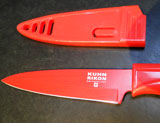
    (*note: since this post, I bought a Shun Chef's knife at Sur la Table and have been using it the most of all my large knives as it has more weight than the Hattori, making it more useful for the wider range of cutting jobs. I still love to use my Hattori Gyuto for fine knife work with vegetables. I also bought an inexpensive Swiss Kuhn Rikon that never needs sharpening and use it more than my expensive Wusthoff or Misono. Just $9.95!)