2/27/12

A Simple Soup

Snow, hail and hurricanes on the East Coast--here in California, it's another perfect day. I harvested a few tomatoes from last year's plants and the collard greens then pulled up the plants, turned the soil and started my spring planting: tomatoes, carrots, onions, garlic, beans, potatoes and chard. A second crop was ready of the English peas planted at the beginning of January--so what to do with the collard greens and peas? I made this simple soup with quinoa, and wanting some protein, stirred in an egg. Delicious!
Soup With Quinoa, Green and Fresh English Peas:

1 tablespoon butter
1/4 cup quinoa
1 stalk celery, deveined and sliced
1 quart vegetable (or chicken) broth
about 2 cups of chiffonaded* collard greens
1 bay leaf
1 teaspoon ground sage
1 teaspoon garlic powder
juice of 1/2 lemon
salt and fresh ground pepper to taste
1 egg, stirred together
Melt the butter in a soup pot over low heat and stir in the quinoa and celery.  Add the broth and bay leaf, turn up the heat to bring the broth almost to a boil, then turn back down to low, cover and simmer for 20 minutes or until the greens are tender. Add the sage, garlic powder, lemon juice and salt and pepper to taste (I used about 1 teaspoon salt and 1/2 teaspoon pepper). When the soup is seasoned to your liking, stir in the egg. Cook and stir gently for a minute until the egg is cooked.

2/21/12

Foodies' Delight

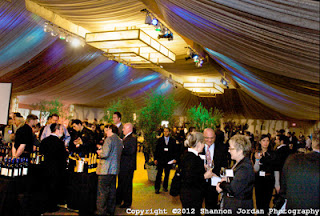
Hyatt Century CityThe gleaming Hyatt Regency Century Plaza in Century City has hosted kings, queens, prime ministers, celebrities and every US President since Lyndon Johnson. In fact, President Reagan spent so much time in the hotel that the press called it "The Western White House". Last Wednesday, the 18th, it was the site of the 2012 Herzog International Food & Wine Festival. The preliminary trade event is THE place to be for Kosher wine buyers with makers from Israel, France, Spain, Australia, Portugal, Italy, Chile, Argentina, New Zealand and the USA, with two booths needed for the wide variety of wines made by Herzog Cellars. The consumer portion is an opportunity to taste wines and spirits often not widely available, not just for those that keep Kosher, but for those of us who are not Jewish but like to taste wines from around the world.
Food at Herzog International Food and Wine FestivalLast year, the Festival was at Herzog's state-of-the-art 77,000 square foot facility in Oxnard, CA. Incongruously set in an industrial park in a city not known for gourmet dining, the facility houses the extraordinary Tierra Sur restaurant, the highest Zagat-rated restaurant in Ventura Country. Chef Aarons has long and varied international resume, including Savoy in New York, Zuni Café in San Francisco and Restaurante Da Delfina in Tuscany, Italy. Chef Aarons creates exotic and mouthwatering cuisine with a Mediterranean flair, from fresh local seasonal produce. At last year's festival he had his own kitchen as the event was at Herzog Cellars. This year, he had to build his own kitchen at the Hyatt location. He looked a bit harried and called the experience "like a Restaurant Impossible" but one would never have guessed at any hinderance to his culinary creation because the food was delicious and beautifully presented.
AppetizersI spent so much of my time sampling the fabulous hors d'oevres that I didn't taste as many wines as I should have. But who could resist the lavish spread with multiple offerings such as hot smoked salmon with black garlic sauce, black cod ceviche in Lapsong tea marinade with Mandarin orange and cucumber, tuna tartar with Za'atar spice (Middle Eastern herbs with sesame seed) pickled eggplant and microcelery, cold smoked hamachi with baby beets and Myer lemon aioli, and Jerusalem artichoke tortillas with salmon roe and black bowfin caviar? To top it off, I had the huckleberry compote and sips of two delicious dessert drinks: the Walders Vodka & Vanilla mixed with pineapple juice and the limoncello from the Israeli winery Binyamina.
Herzog International Food & Wine FestivalAs for the wines, I had the Chateau Leoville Poyferre stuck in my mind from the 2011 Herzog Festival----so I made a beeline to their booth to try the Bordeaux. I tasted the 94 point 2004 last year and thought the 93 point 2005 just as luxuriously complex, smoky and rich. Next stop was Capçanes, made by the eponymous village in the Priorato hills of Spain where the grape growers formed a cooperative, producing about 2% of their wines under Kosher conditions. They have become world renown, garnering high ratings of 90+ points. Touring & Tasting had the Mas Donis Barrica at one time--a spicy, fruit-forward Garnacha with a bit of Syrah. I enjoyed the 95 Point Peraj Ha'abib which is a powerful blend of Garnacha, Carinena and Cabernet Sauvignon. The name Peraj Ha'abib was a fortunate mistake--a rabbi translated spring flower erroneously as Peraj Ha'abib, instead of Peraj Ha'aviv. But Ha'abib means is a term of endearment, so it gives the wine a loving touch. Other highlights: Herzog's dense and chocolately 2008 Chalk Hill Cab, the Domain Netofa 2009 Latour Red blend of Syrah and Mourvedre, and the Chilean Alfasi 2011 Cabernet Sauvignon.
Herzog International Food & Wine FestivalWe scooted out of the trade tasting just in time as motorcycle cops were starting to line the Avenue of the Stars in advance of President Obama's motorcade. I'll be keeping a lookout on the Herzog website for upcoming food and wine pairing events at their restaurant to taste more of Chef Aarons tasty treats and sample more of the Herzog wines--some only available at the winery. I haven't been to one of their wine and food pairing evenings, but see on their events calendar that past tastings are just $15--worth making the drive to Oxnard!
Photos by Shannon Jordan Photography.

2/12/12

Authentic Teriyaki

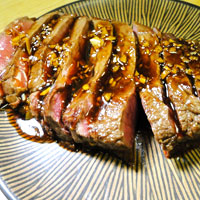
Restaurant teriyaki is usually made (I've never seen otherwise) by grilling meat and pouring sauce over it. This authentic recipe uses the pan juice from the meat to flavor the teriyaki and is infinitely better. You can use chicken or salmon as well--the chicken must be cooked through and not rare inside and the salmon just barely cooked in the center (it will continue cooking after it is taken from the heat).
Tama's Steak Teriyaki:
1 teaspoon minced ginger
1 teaspoon garlic
2 tablespoons Mirin* (Japanese cooking wine)
1 tablespoon packed brown sugar
2 tablespoons. soy sauce
2 tablespoons sesame oil
1 steak
4 tablespoons saké*
*Note: Mirin and saké are not the same--Mirin is sweet with just a touch of alcohol, saké is very dry and has a high alcohol content)
Mix the ginger, garlic, Mirin, sugar and soy sauce in a small bowl. Heat oil in a large frying pan (cast iron works best) over medium heat until oil is hot but not smoking.

Add steak and sear on both side. Add the sake (there may be quite a bit of smoke/steam) and let cook for half a minutes as the alcohol burns off. Remove the steak and let sit. Add the soy sauce mixture and evaporate by half, scraping up any browned bits into the sauce. When the sauce is thickened, turn the heat to low and cook the steak another 2-3 minutes, turning several times to coat it on all sides. The steak should be seared on the outside and rare in the center. Let the meat sit for 2 minutes to redistribute the internal juices, then slice into 1/2" slices. Spoon the remaining sauce over the top.

I've been so busy uploading recipes to Touring and Tasting' new website, after being named Food Editor (yay!) and posting to their blog that I haven't had time to enter anything here.

I like having a food blog because I have so many of my recipes on it and can access it via smartphone or computer if I need.

WEEK #3 PRINCIPLES OF BAKING--CULINARY SCHOOL
There's so much to learning about baking--scaling, proper proofing, benching, rounding, use of steam...I hope to have to to blog about it this week. In our last class, we made monkey bread--easy to make and it was appreciated at the Touring and Tasting office when I brought it in the next day. It's basically round, sweet rolls covered in brown sugar and cinnamon and baked until the sugar is caramelized. Next time I make it, I will add walnuts to the coating.

Monkey Bread:
4 3/4 cups bread flour
1 1/2 teaspoons salt
1/4 cup powdered milk
31/4 tablespoons sugar
2 1/2 teaspoons active yeast
1 large egg, slightly beaten
3 1/4 tablespoons butter, melted
1 1/2 cups to 1 3/4 cup cold water
1 cup or more sugar
1/2 cup or more cinnamon
Mix the flour, salt, powdered milk, sugar and yeast in a mixer bowl.  Add the egg, butter and 1 1/2 cups water and mix with the paddle attachment of your mixer or with a large spoon until the flour is absorbed and the dough forms a ball. Add water in bits only if the dough doesn't come together. The dough should be soft and moist.
Replace the paddle with a dough hook and knead until the dough is smooth and elastic (or knead by hand on a lightly floured board). The dough should clear the sides of the mixture but stick just a bit on the bottom of the bowl. It should pass the "windowpane test" where it a small portion can be stretched to where one can see shapes behind it, without the dough tearing.
Oil the bowl and turn the dough around in it to coat with oil. Let proof for 1 1/2 to 2 hours in warm area or until it doubles in size.

Preheat your oven to 350 degrees. Mix the sugar and cinnamon in a bowl. Using a scale, scale out 2 oz portions. Always cut the dough with a bench scraper or chef's knife--do not tear apart. Round each portion into a ball and roll in melted butter, then in the sugar mixture. Put into an ungreased savarin or angel food cake pan. The portions will form a ring when proofed and baked, but each will be easy to pull off. Let the monkey bread rise for another 45 minutes, then bake in the oven for about 30 minutes or until the bread is cooked through and the outside is nicely browned. Let sit a few minutes too cool as the sugar will be hot--it will be hard to let them sit, because they will smell wonderful!


1/30/12

WEEK #2 Culinary School -- Principles of Baking

I never knew that salt is the most important ingredient in baking after the flour. It controls fermentation of the yeast and contributes to the quality and color of the crust. Proper proportion is essential to obtain the texture and flavor desired. I'm learning all the basics of baking in my spring semester class at the School of Culinary Arts at SBCC with Chef Sandra Allain.

I'm hoping to learn how to make top notch pie crusts, ciabatta, flaky croissants and more! The first two classes were spent going over the prelimary chapters in our textbook: Professional Baking by Wayne Gisslen. I can't wait for next week when we get into the kitchen to bake--plus my "baking buddy" lived in Florence, Italy for three years, so I hope to practice my rusty Italian!

1/12/12

Creamy Polenta Tamale Casserole

What do you make when you have homemade chile sauce already made and your heart set on enchiladas, but you open your frig and find you have no tortillas? I made this casserole with creamy polenta and it was delish. We had a couple of Napa wines to try: Rocca Family Vineyards 2007 Merlot and the 2008 Vespera. Both were good. I preferred the fruitiness of the Merlot with the spiciness of this dish, but the Vespera's chocolately smoothness would be my preferred sipping wine.

Creamy Polenta Tamale Casserole: 
Ingredients:4 Tbsp. butter
2 Tbsp. flour
2 cup milk
1 cup cornmeal
2 Tbsp. olive oil
1 shallot, minced about 1/2 cup
4 cloves garlic, minced
4 sausages, sliced--either vegetarian or pork sausage
1 cup corn kernels, fresh or canned
1 stalk celery, finely chopped
1 red bell pepper, finely chopped
2 cups red chile sauce or red enchilada sauce
2 cups grated sharp cheddar
*optional: finely minced parsley

Directions:
Preheat the oven to 350 degrees. Melt butter, add flour and cook over low heat for a couple of minutes. Do not let it brown. Add the milk and cornmeal and cook until thickened, stirring occasionally. Set aside. Coat the bottom of a saucepan with oil and sweat (cook without browning) the shallot and garlic over low heat. Add the sausage, corn, celery, and bell pepper. Continue cooking for another five minutes, stirring occasionally. Add the red chile sauce, stir, then pour into the bottom of an 8" round casserole. Using a spatula, spread the mixture evenly across the bottom of the dish. Stir the cornmeal, if it is not liquid enough to pour easily, add enough water, mixing thoroughly to make it pourable without being runny. Pour over the vegetable mixture and smooth with the spatula. Sprinkle with the cheese and bake for 40 minutes. Sprinkle each portion with parsley, if desired. Serves 4.

1/9/12

Smoking Your Own Fish And Smoked Whitefish Spread

The alluring aroma of hickory smoke curled around my neighborhood last week prompting my neighbors to track down the source and to let me know me that they LOVE smoked fish. Santa brought me a Brickman smoker/roaster/steamer/grill for Christmas and I had my first two forays into the world of smoking. The Brickman has a fire pan at the bottom for the coals and aromatic hardwood, a water pan in the middle that can be filled with beer or herb infused water, and two grills--one directly above the water pan for a steaming and one at the top for conventional smoking. Doesn't their description sound tempting? "Here's how it works: 
The liquid in the pan absorbs the heat from the firs pan. This keeps cooking heat low, moist and even. The water reaches simmering temperatures and steams slightly. The simmering water evaporates and combines with smoke from aromatic woods smoldering in the fire pan. This fragrant moisture condenses on the food, then drips into the liquid pan. As the cycle is repeated, the moisture becomes more deliciously flavored with wood tenderness." Yes, it does!

I found fatwood starters and oak charcoal at Ralph's without any chemicals (I hate the aroma of starter fluid) and used the hickory chunks that came with the smoker. I wrapped both the fire and water pans with aluminum foil and put a sheet under the smoker to catch any ash that came out of the vent hole on the bottom. Clean up was a snap. I tried different sizes of fish--the smallest ones (size of a kebob chunk) were nearly as dry as jerky and the larger fillet pieces had plenty of surface area to capture the smoky flavor, but enough thickness to be moist. I would say 2" would be the thinnest one would want a piece to be, unless you're looking for jerky.

The helpful seafood monger at Whole Foods sold me salmon and whitefish and recommended 1 cup rock salt: 1 cup brown sugar: 1 quart water as a 24 hour brine for the fish. Unfortunately, the first batch made this way way to salty, so I used the whitefish in the spread recipe below. The cream cheese and sour cream diluted the saltiness so the spread was delicious with a French baguette at a recent winetasting of Pinot Noir at work.

The second day, I made my own brine with 1/4 cup rock salt: 1/4 cup brown sugar: 1/4 cup maple syrup: 1 tsp. fresh thyme and brined the fish for about 2 hours. We tried it at the same Pinot Noir tasting--the fish was excellent, but perhaps the smoky flavor a bit overwhelming for the more delicate Pinots.

A note: marinated fish and meat need to sit out in the air after being removed from the brine or marinade. When the air can contact all sides, it dries out the surface and develops a pellicule which is a thin layer of tackiness that the smoke adheres to--I simply placed the fish on a rack for half an hour. In the same smoking, I smoked a pork loin marinaded in red chile sauce that was devoured by my carnivorous family. Next time: smoked oysters and smoked chuckwagon beans!

SMOKED WHITEFISH SPREAD:
8 ounces whipped cream cheese
1/2 cup sour cream
1/2 pound. smoked whitefish, skinned, boned and flaked
1/4 cup finely chopped red bell pepper
2 tablespoons fresh dill
1 teaspoon freshly ground black pepper
1/2 teaspoon. horseradish

With a spatula, combine cream cheese and sour cream in a mixing bowl until well blended. Stir in the fish and favorings, then spoon into a serving dish. Refrigerate for an hour or longer, serve with sliced bread or crackers. Makes about 2 cups of spread. Pair with a strong Pinot Noir or a Chardonnay.

12/30/11

What To Expect From The French Laundry Napa Valley and Wine Pairing

Synopsis: World renown 5 star restaurant is a once in a lifetime experience--around 14 courses of exquisitely prepared miniature dishes that please the eye and palate. Pair light wines like champagne or Pinot as the flavors are delicate.
The French Laundry
Once a laundry, saloon and brothel, now a world-renown restaurant, The French Laundry was founded in 1994 by Chef Thomas Keller in Yountville, Napa Valley. Chef Keller was named "America's Best Chef" by Time magazine and "Chef of the Year" by the Culinary Institute of America plus he won consecutive "Best Chef" awards from the James Beard Foundation. Naturally, The French Laundry is at the top of any foodie's "bucket" list, so I was thrilled that we had reservations after several years of trying to obtain one without success. I must not have been the only first time customer apprehensive about what to expect at this venerable establishment, since The French Laundry website even has a page entitled "What To Expect" where they say "...that's how we try to welcome you--as a guest in a home we love".
Salmon Tartare
Indeed, the place looks more like a home that a famous building, with their sign nearly hidden in the foliage in front. We were early for our 5:30 reservation, so we peeked into the kitchen while we waited for the front door to open. A bevy of chefs were prepping in an immaculate but not ostentatious kitchen. We were welcomed into the restaurant, which continued the theme of modesty with its simple decor. The room was lit with candles and soft light, with comfortable chairs and quality place settings and stemware, but there is nothing pretentious or stuffy about the atmosphere. The feeling is one of warmth and welcome.
We had downloaded and perused the wine list prior to arriving and had decided that wines by the glass would give us a more affordable way to try a number of different selections. The French Laundry wines by the HALF bottle range from $45 to $1,285. We found wine by the glass that fit our more modest budget: the Weegmüller "Haardter Herzog" Kabinett Riesling and the Pierre-Yves Colin-Morey "Les Vireuils" white Burgundy which we thought had an off-taste and exchanged for the HdV "Hyde Vineyard" Chardonnay from Carneros. One can choose between the regular Chef's Tasting Menu and the Tasting Of Vegetables--we had one of each.
Salad Of Hachiya Persimmon
Prior to our first course, we were brought two tiny (about 1" wide) warm gougeres filled with melted cheese--fantastic! Then, two tiny "ice cream cones" of salmon tartare. I unobtrusively took photos at our corner table with my iphone--the light was dim, so the photos are not the best. The salmon cones look large--but they were about 2" tall--just a bite of salmon with a cream interior and crispy shell. Our first courses of the menu were Baked Sierra Beauty Apple for me--reminiscent of an apple betty--and "Oysters and Pearls" for Paul, which was a creamy mixture of tapioca, caviar and oysters--one of the evening's best dishes.
Celeric "Gratin"
Next on the vegetable tasting for me was the Salad of Hachiya Persimmon with heirloom beets and petite greens. The greens were precious--one tiny sprig was the size of half my pinkie fingernail. I liked the sweet persimmon, but the beet slivers were about the size of a slivered almond, so it was difficult to taste their natural rich flavor. Paul's salad was the Salsify "En Feuille de Brick", also with the tiniest bits of salsify, Asian pear, radicchio, walnuts and radicchio. The flavors were lovely but delicate and would have been better with a brut champagne or dry sparkling wine, even though I loved the nectar-like aromatics of the Riesling.
"Caesar Salad"
We switched to a glass of the Maume Gevrey-Chambertin "En Pallud" from Burgundy (a Pinot Noir) and a glass of the Hirsch "San Andreas" Pinot Noir from Sonoma Coast to go with the Celeriac "Gratin", which had a nice creamy sauce that went well with the chestnuts in the dish, and the Sautéed Fillet of New Zealand Medai which had chorizo and piquillo peppers spicing it.
Garnet Yams "En Cocotte"
Paul's next course was a deconstructed "Caesar Salad" with tender lobster "mitts" and a few wisps of romaine. The photo make it look large, but it was in fact a gem-like square about 2" wide plated in the middle of a very large white plate. It comprised a tasty two bites of lobster with a hint of garlic and butter.
Salmon Creek Farm Pork Belly
I had the Garnet Yams "En Cocotte" --a vegetable lover's delight. I was thrilled to see the humble yam given formal tableside service usually reserved for fish or meat. A cart was wheeled to our table with several covered silver dishes. One was opened to reveal Savoy cabbage chiffonaded and gently cooked. It was carefully spooned into the serving dish. Another silver lid was lifted to reveal the yams that had been baking in maple syrup--they were placed on the cabbage, topped with tiny Candy Cap mushrooms, then soaked with the bourbon maple syrup sauce. This was another of the evening's top dishes and paired perfectly with Pinot Noir.
"Calotte De Boeuf Grillée"
Paul's next two meat courses were the Salmon Creek Farm Pork Belly and Snake River Farms "Calotte De Boeuf Grillée" which he declared delicious. My Niçoise Olive "Garganelli" had tubular pasta made from special eggs flown in from Japan. Unfortunately, I could not taste the difference and it seemed a shame to have spent the money for such an expensive ingredient when a locally raised organic egg surely would have made an excellent pasta. I also thought the pasta was a little too "al dente" and this was the only non-dessert dish I was served that I did not devour in its entirety.

"St Nectaire"
The "St Nectaire" was a carefully composed combination of wilted radicchio, truffled bread bits and a prune puree that had less flavor than I would have expected from the name and the listing of ingredients.
"Pecan Pie"
However, the next four courses were the gastronomic equivalent of the end of a fireworks show when all guns are fired for a grand finale. Despite the tiny servings, the number of dishes we had already consumed had already sated us--but the desserts were irresistible. Sorbets were served to cleanse our palate--sour cherry or buttermilk. My buttermilk sorbet was just a spoon's worth, but it was all that was needed. Imagine the brightest, cleanest, freshest taste of dairy hitting your mouth with a flash of cold, then melting away instantly like a snowflake!
Buttermilk Sorbet
The "Pecan Pie" With Verjus-Poached Honey Pears was the perfect amount of sweetness loaded with pecan flavor. Our dessert course was quickly followed by extra treats--warm, fresh miniature donuts, macadamia nuts rolled in chocolate, chocolate truffles with various fillings and an unbelievably delicious "caffe fredo" which was a tiny cup with frozen coffee cream topped with an airy mixture that looked like steamed milk but must have been the lightest foam of meringue. We had been asked about any allergies at the beginning of the meal and I mentioned that I didn't eat chocolate, so I wasn't served the chocolate soufflé--there was no need at this point as I could not have had another bite, no matter how delicious.
Desserts
For wines to pair with the dessert courses, we chose the Oremus Tokaji Aszú 5 Puttonyos and the D'Oliveira Verdelho "Reserva" Madeira--two types of wines we had never tried. I remember my wine class teacher in Culinary School Antonio Gardella rhapsodizing over Hungarian wines and saying that though they are rare in the US, they historically have been considered in Europe as being on a par with French grand cru, so I was very interested in trying the Tokaji Aszú. The grapes are allowed to contract Botrytis cinerea or "noble rot" which concentrates the flavor. The Tokai was lusciously sweet and aromatic as nectar. The Madeira was smoky and woody and did not pair as well with the desserts. Overall, if I could redo our wine choices, I think I would choose a dry champagne for the savory dishes since the flavors were so delicate. Some of the ingredients are served in such tiny amounts, that their flavors were diminished. The sauces were exquisite, but none were strongly flavored. Even the meat dishes would not pair well with a powerful red like a Cabernet Sauvignon as the decisively tasty meat portions were around 2" long and the other parts of the dish prepared with a light touch. I think the Pinot Noir we had paired was as strong a red wine as could be paired successfully with the meal we had. The one exception was the yam dish which was the most powerfully flavored dish and was perfect with our Pinot.
Besides the beautifully prepared food, the French Laundry experience was remarkable for the service. The servers silently and unobtrusively place and remove utensils and plates. We witnessed the graceful choreography as they served all the diners at the adjoining table of eight simultaneously without any fanfare or superfluous movements. Our waiter was knowlegeable and affable, happy to answer our many questions, plus he gave us a copy of the day's menu which is below, plus little bags of yummy shortbread cookies.
However, The French Laundry will have to be third on the list of the best dining experiences in my life behind the two kaiseki meals I had in ryokans in Japan: the Hiiragiya Ryokan in Kyoto and the Kankaso Ryokan in Nara. Multiple courses are served to you in your room, each presented on a priceless dish--an heirloom pottery bowl, a gilt enameled plate, a gorgeous natural stone, an elaborate laquered tray hundreds of years old--and the composition of the food creates a piece of art that complements the serving dish and reflects the season of the year. The tastes are carefully orchestrated to encompass all varieties of cooking techniques, textures, flavors and colors creating an amazing variety in the dining experience. Obviously, the quality of ingredients and technique at The French Laundry are the very best, but the texture of the dozens of ingredients in the savory dishes tended to be the same softness as if everything had been cooked sous vide. The fresh greens that garnished many dishes were so miniature that their texture was barely discernible. That note aside, we had a wonderful meal (which took around three hours to experience) and a once-in-a-lifetime taste of the virtuosity of one of the world's best Chefs.
c h e f ’ s t a s t i n g m e n u | 2 8 De c e m b e r 2 0 1 1
PRIX FIXE 270.00 | SERVICE INCLUDED
6640 WASHINGTON STREET, YOUNTVILLE CA 94599 707.944.2380
_______________________________________
“OYSTERS AND PEARLS”
“Sabayon” of Pearl Tapioca with Point Reyes Oysters and White Sturgeon Caviar
ROYAL OSSETRA CAVIAR
Maine Sea Urchin, White Truffle, Sicilian Pistachio and “Sablé”
( 50.00 supplement )
_______________________________________ 
SALSIFY “EN FEUILLE DE BRICK”
Asian Pear, Tardivo Radicchio, Black Walnuts and Mizuna
MOULARD DUCK “FOIE GRAS AU TORCHON”
Honey-Glazed Cranberries, Pecans, Oxalis and Black Winter Truffle
( 30.00 supplement )
_______________________________________ 
SAUTÉED FILLET OF NEW ZEALAND MEDAI
Chorizo, Littleneck Clams, Piquillo Peppers, Spanish Capers and Saffron “Nuage”
“ST. PIERRE AVEC MOUSSE AU CRABE”
Petite Onions, Nantes Carrots, Tokyo Turnips and “Sauce Bordelaise” ( serves two )
_______________________________________ 
“CAESAR SALAD”
Sweet Butter-Poached Maine Lobster “Mitts,” Caramelized Romaine Lettuce, Garlic Melba and “Bottarga di Muggine”
_______________________________________ 
SALMON CREEK FARM PORK BELLY
Young Fennel, Ruby Red Grapefruit, Sunchokes and Niçoise Olives
FOUR STORY HILL FARM “CUISSE DE POULARDE”
French Laundry Garden Cabbage, Pomegranate, K&J Orchard Chestnut and Black Truffle
_______________________________________ 
SNAKE RIVER FARMS “CALOTTE DE BOEUF GRILLÉE”
“Pommes Darphines,” Chanterelle Mushrooms, Petite Radish, Red Ribbon Sorrel and Green Peppercorn Sauce
_______________________________________ 
“VERMONT SHEPHERD”
Baby Beets, Celery Root and Piedmont Hazelnuts
_______________________________________ 
SOUR CHERRY SORBET
Coconut “Petit Beurre” and Vanilla “Soda”
_______________________________________ 
ALPACO “MOUSSE AU CHOCOLAT”
Spice Pudding, “Panna Cotta,” Fuyu Persimmon and Marcona Almond “Glacée”
“POMMES ANNA”
Funnel Cake, “Pruneaux d’Agen,” Rum “Anglaise”
and Salted Caramel Ice Cream
_______________________________________ 
MIGNARDISES


t a s t i n g o f v e g e t a b l e s | 2 8 D e c e m b e r 2 0 1 1
PRIX FIXE 270.00 | SERVICE INCLUDED
6640 WASHINGTON STREET, YOUNTVILLE CA 94599 707.944.2380
_______________________________________ 
BAKED SIERRA BEAUTY APPLE
Granola, Garden Blossoms and Yogurt Mousse
_______________________________________ 
SALAD OF HACHIYA PERSIMMON
Heirloom Beets, Petite Greens and Spice “Gastrique”
_______________________________________ 
CELERIAC “GRATIN”
French Laundry Garden Celery, K&J Orchard Chestnuts, Gingerbread and Honey-Poached Cranberries
_______________________________________ 
HERB-ROASTED SALSIFY
Poached Quail Egg, Piedmont Hazelnuts, Mizuna and Périgourd Truffles
BUTTERNUT SQUASH “BISQUE”
Maine Lobster “Mitts,” Creamed Hearts of Romaine and Black Winter Truffle
_______________________________________ 
GARNET YAMS “EN COCOTTE”
Candy Cap Mushrooms, Savoy Cabbage, Red Walnuts and Bourbon Maple Syrup
_______________________________________ 
NIÇOISE OLIVE “GARGANELLI”
Cavolo Nero, Jingle Bell Peppers, Spanish Capers, Pine Nuts and Garlic Confit
VIDALIA ONION “RISOTTO”
Hobbs’ Bacon, Nantes Carrots, Shallots,
Scallion Salad and Port Wine Reduction
_______________________________________ 
“ST. NECTAIRE”
Black Truffle “Pain Perdu,” Tardivo Radicchio, “Pruneaux d’Agen” and Sicilian Pistachios
“WELSH RAREBIT”
Cabot “Clothbound Cheddar,” Cauliflower Florets and Bitter Ale Béchamel
_______________________________________ 
BUTTERMILK SHERBET
Oregon Huckleberries and Marcona Almond “Waffle”
_______________________________________ 
COEUR DE GUANAJA CHOCOLATE “SOUFFLÉ”
Banana Ice Cream and Burnt Lemon-Caramel Sauce
_______________________________________ 
“PECAN PIE”
Verjus-Poached Honey Pears, Maple-Brown Butter “Gastrique” and Grains of Paradise Ice Cream
_______________________________________ 
MIGNARDISES

12/18/11

To Die For Pavlova With Raspberry Coulis

A double win as I made this dessert twice recently and everyone raved about it! One friend said it was the best dessert he'd ever had--pretty big words!

Raspberry Pavlova With Raspberry Coulis and Fresh Fruit
 
Chef's Notes:
Your mixing bowl and whisk must be very clean, dry and grease-free to make proper meringue. Also, the whites will not whip up properly if there is even a speck of yolk in them.
Ingredients For Meringue:
    •    6 egg whites
    •    1/2 tsp. cream of tartar
    •    1/2 tsp. cornstarch
    •    2  cups superfine or castor sugar
    •    1 tsp. lemon juice
    •    1 tsp. vanilla extract
Directions For Meringue Shell:
Preheat the oven to 200 degrees. Put egg whites, cream of tartar and cornstarch into a very clean, dry mixing bowl and whip on high speed until peaks just start to form. Turn the speed to medium and slowly add the superfine sugar. Add the lemon juice and 1 tsp. vanilla and continue mixing until the meringue is smooth and glossy. Do not over beat the meringue, but make sure the it is not gritty--that would indicate the sugar is not fully mixed in.
Line a baking pan with parchment and draw a large circle in the middle with pencil if making one large Pavlova--you can invert a large bowl on top and trace the outline. Alternatively, use a 4" wide bowl to make individual Pavlovas. Put four little drops under the four corners of the parchment paper so it will stick to the baking sheet. Using a pastry bag, pipe the meringue into a circle, starting in the center and making concentric rings. Finish by piping a decorative border around each circle. Bake until the meringue is set, about 1-1/2 to 2 hours. The meringue should be firm but not brown. Turn off the oven, leave the door ajar and let the meringue in the oven to finish drying for about an hour.

Ingredients for Raspberry Coulis:
    •    2 10 oz. packages frozen raspberries
    •    1/2 tsp. vanilla for puree
    •    1 cup sugar
Direcions For Raspberry Coulis:
While the meringue is cooking, put 1/2 cup water, raspberries and cup of granulated sugar into a saucepan and bring to a boil. Turn the heat down and simmer the sauce for 10 minutes or until the sauce thickens by a third. Set aside to cool enough to strain through a china cap or cheesecloth to remove the seeds. Put into a glass container and chill in the refrigerator.
Other Ingredients:
    •    1 pint whipping cream
    •    1 pint of fresh fruit of your choice: raspberries, blueberries, sliced strawberries or blackberries
    •    1/2 cup slivered and toasted almonds
Directions For Whipped Cream:
Put the whipping cream into a clean mixer bowl and whip until soft peaks form.

To Assemble The Pavlova:

Plate the meringue shell(s), fill with whipped cream and drizzle with raspberry puree, Decorate with fresh fruit, sprinkle with toasted almonds and serve immediately.


BTW, I discovered something delicious to drink: tonic water with lemon made with Tom's homemade tonic syrup. The taste is so much better than store bought tonic--it's slightly sweet and pleasantly bitter. Lovely on ice with my homegrown Meyer lemons!
Find it here.

12/15/11

Elegant Salmon Cakes

Less expensive than crab cakes, but just as elegant, salmon cakes with Hollandaise sauce pair beautifully with a Pinot Noir.

Salmon Cakes With Hollandaise Sauce:
Ingredients for salmon cakes:
3 small waxy potatoes, such as red or Yukon Gold, to make 1/2 cup
1 egg
1 6 oz. can salmon
1 tsp. minced fresh dill
2 Tbsp. fresh minced parsley
pinch freshly ground black pepper
1/4 tsp. salt
1 1/2 cups, approximate, panko bread crumbs
3 Tbsp. ghee or clarified butter

Directions for salmon cakes:
Peel and slice the potatoes, place into a pot, cover with water and bring to a boil. Cook around 10 minutes or until the potatoes are softened but not mushy. Drain, let cool, and cut into a small dice--cubes about 1/8" on each side. In a mixing bowl, stir the egg with a fork until well mixed, add the salmon and flake it apart with the fork. Add the dill, parsley, pepper and salt and stir until mixed. Pour the bread crumbs into a shallow bowl. Divide the salmon mixture into four parts and form each one into a ball, then pat into a patty. Carefully place in the panko, turn and coat the other side. Heat the clarified butter in a large frying pan (see here on instructions on making clarified butter) over medium heat and add the cakes. Turn the heat to low and cook for about 10 minutes or until the cakes are browned on the bottom. Flip and cook 5 more minutes or until browned on the second side. Cover to keep warm as you make the Hollandaise.

Ingredients for Hollandaise:
1/4 ghee or clarified butter
2 egg yolks
3+ Tbsp. warm water
juice of 1 lemon, about 1/8 cup juice
dash Tabasco sauce
1/2 tsp. salt
dash white pepper
Directions for Hollandaise:
Warm the butter and pour into a measuring cup (you can microwave the butter in the cup for 20 seconds). Use a bain marie or double boiler--bring the water in the bottom pot to a low boil. In the top pot, whisk the egg yolks with 3 tbsp. water. Slowly drizzle the butter into the egg yolks, whisking continuously. Drizzle in the lemon juice, whisking continuously, then add the Tabasco, salt and pepper. Continue cooking and whisking until the sauce thickens enough to coat the back of a spoon. If it becomes too thick, whisk in more water until you have the right consistency.
Serves 2.

12/1/11

Culinary Class Final -- The Perfect Egg

WEEK #15 CULINARY CLASS FINAL:
Eggs are the easiest ingredient to cook because they are so versatile and cook easily at a low heat. Obversely, they are one of the most difficult to cook well for two reasons: because they become leathery when overcooked (at temperatures above 180 degrees), and because the egg yolks solidify (cook through) at 149-158 degrees whereas the whites solidify at 144-149 degrees--meaning that theoretically, the temperature should be exactly 149 to cook the entire egg evenly. (read the Discover article on the perfect boiled egg). Incidently, if you see green around the yolk of a boiled egg, it was cooked either at too high a temperature or too long. The green is from hydrogen sulfide in the white interacting with iron in the yolk and will give off a "rotten egg" smell.
So, no wonder our culinary class final was to make a French rolled omelette, cooked through evenly, with no browning on the surface and seasoned well--a measure of our pan control and seasoning ability. We also had to demonstrate our knife skills with brunoise, julienne and dice. The most difficult is the large dice. Try making several 3/4" cubes from a carrot with perfect 90 degree angles and identical size! For those who are interested, here's the method to make the perfect French omelette (no browning or crispiness on the outside as many American omelettes are made): whisk 2 eggs with a tablespoon of water (not milk or cream as the fat inhibits the protein in the egg from encasing water in the omelette--which gives the moistness to the finished product), adding salt and pepper (and herbs if desired). Coat the bottom of your pan with oil and pour off any excess, heat it so the eggs will sizzle when added--no sizzle means the eggs will stick, stir the eggs with a heat resistant spatula and fold the edges in towards the middle. When the eggs are starting to set but still moist, "paint" the eggs across the bottom of the pan so the layer is even, then cook carefully--taking the pan off the flame and putting it back on to maintain a low temperature until the egg is almost set through. Lift one edge of the omelette and roll it up and onto a plate. Let it sit for a minute to complete cooking. When sliced in half, their should be a pinwheel pattern of the rolled eggs and the eggs should be moist but cooked thoroughly.
Thanksgiving leftovers are delicious! Wrap them up in dough, bake and serve with a rich Syrah.
Empanadas with Thanksgiving Leftovers:
Pastry for Empanadas:
1 egg plus 1 egg yolk
1 1/2 cups flour
1/2 tsp. salt
1 stick cold butter
1/4 cup cold water
In a small bowl, mix the egg and extra yolk slightly, using a fork. In a mixing bowl, mix the flour and salt. Using a pastry blender or two dinner knives (cross the blades so they act like scissors), cut the butter into the flour until the butter bits are less than 1/4" across. Mix in the egg with half of the water, mixing quickly with the fork until the dough just comes together, adding the rest of the water as necessary.  Knead quickly on a floured board, only to incorporate all the ingredients. Wrap the dough in plastic and refrigerate for at least an hour.
Making Empanadas:
Preheat the oven to 375 degrees. Unwrap the dough. Spread out the plastic wrap and pat the dough flat. Put another piece of plastic wrap on top, then roll out the dough to 1/8" thickness. Cut into 6" circles using a cookie cutter or lid. Put leftover turkey, dressing, gravy and/or cranberry sauce in the middle, leaving 1/2" border of dough around the edges. You can also use a good melting cheese instead of gravy--like cheddar or Gruyere. Fold the dough in half and press the edges together to seal. If the dough is not sticking together, paint a bit of water or milk in the seam, then seal. Bake for 15-20 minutes until pastry is golden brown. Serves 4.

11/17/11

The Baker's Dozen Of Culinary Class: #13

WEEK #13 CULINARY CLASS:
In preparation for Thanksgiving our culinary class made turkey 3 ways--stuffed with aromatics and roasted whole on a bed of mirepoix, restaurant-style--butchered, seared and roasted on mirepoix, and deep-fried. And of course, the fixin's: a mashed potato-sweet potato mixture, green beans, cranberry sauce, and gravy. No big surprises, since I've been making Thanksgiving dinner for about 30 years. After so much trial and error, I've found the ultimate for perfect roast turkey: buy an organic, free-range bird that hasn't been frozen, brine it overnight, coat it liberally with paprika, roast with a buttered cheesecloth over the breast for the first hour, baste liberally during cooking, let it sit 20 minutes before carving--it's always moist and tender. (see recipe) But, this year, we're having something different: pork loin stuffed with apples and walnuts and deboned turkey leg stuffed with cranberries and wild rice. The latter I learned in class this week--how to debone the leg, roll it and tie it (same trussing technique as the pork loin). Video one below shows Chef Charles Fredericks butchering a turkey, video two demonstrates how to truss meat.
Roast Pork Loin Stuffed With Apples and Walnuts:
2 1/2 lb. boneless center cut pork loin roast, butterflied
salt and fresh ground black pepper
3 Tbsp. olive oil
3 shallots, peeled and minced
2 Tbsp. minced garlic
2 Granny Smith or Pippin apples, peeled, cored and chopped
2 tsp. minced fresh rosemary plus several sprigs
4 Tbsp. brown sugar
1/2 cup toasted walnut pieces
5 cups mirepoix: a mixture of onion, carrot and celery chopped into uniform size, in the ratio of 2 parts onion to 1 part carrot and 1 part celery
8 oz. chicken broth
1/2 cup red wine--some of the Syrah you will pair with the dish will work well
Toast the walnut pieces under the broiler. Remove and let cool. Preheat the oven to 350 degrees. In a large skillet, cook the shallots and garlic in oil until the onion is translucent--do not brown. Add the apples, minced rosemary, and brown sugar and cook until the apples start to soften. Adjust seasonings, if needed. Set aside to cool, then stir in the walnuts.

Tie Before Trussing
Have your butcher butterfly the roast or do it yourself by slicing through it lengthwise partway--leaving 1 1/2" intact so you can open it up like a book. Put the roast on plastic wrap and cover with a sheet of plastic wrap. Pound the meat with a meat tenderizer until is is flat. Remove from the wrap and salt and pepper both sides. Run the stuffing in a line down the middle and roll up. Use cooking twine to tie it up in three places, then truss it securely (see video). Put the mirepoix in a deep roasting pan, put the roast on top, arrange sprigs of rosemary around the roast and add the chicken broth. Roast in the oven about 1 hour, until internal meat temperature is 135 degrees, basting with the broth in the pan a few times during the cooking process. Remove roast, tent with foil to keep warm as you make your pan sauce reduction.
Strain the broth and put into a saucepan. Add the wine and cook over high heat until reduced by half. Season to taste with salt and pepper. Remove the twine that trussed the roast, slice into 1 1/2" pieces and drizzle with sauce. Enjoy with a glass of the handcrafted 2008 Jason-Stephens Estate Syrah.


11/11/11

Veterans Day and the Kitchen Table Gang Trust

Baby Boomers like me grew up under the shadow of the Vietnam War. I was a child at the tail end of the 1960s and marched with my parents in peace and civil rights marches. Back then, police were called "pigs" and the military was hated because it drafted brothers, sons, and boyfriends to fight a war that most of us didn't want. I'm still a pacifist and wish our military had not gotten involved in the Middle East, but age and experience has tempered my views of the military. Having met young people who enlisted to make a living in this tough economy, with military enlistment their only hope for a college degree, I have compassion for our troops. Most of them are just kids, just out of high school, and probably naive about what lies ahead in the battlefield. So, when I heard a heartfelt message from Michelle Obama to support our troops, I looked at the Kitchen Table Gang Trust website, run by veterans, which can provide addresses for active military personnel serving in harm's way. I packed beef jerky, ziploc bags and wipes to protect from the dusty wind in Afghanistan, cans of tuna and salmon, nut bars, dried fruit and good Columbian coffee.
A friend of mine, Adam, just returned from half a year in Kabul working as a engineer for a contractor. He was in a restaurant next to the store that was blown up in June, so spent the rest of his time there either in the guarded compound or going out in the field in a heavily armored convoy. Life is precarious in Afghanistan--both for Americans and Afghans. It's difficult to imagine living in fear for one's life, another reason I feel compassion for our young people who find themselves there. You can read about Adam's experience on www.empowertothepeople.org/

11/10/11

How To Fillet A Fish Like A Pro

Chef Charles Fredericks SBCC School of Culinary Arts
WEEK #12 CULINARY CLASS:
Another excellent class with Chef Fredericks who explained the difference between round and flat fish, covered two cooking competencies: searing and poaching, and how to make court boullion and beurre blanc and how to fillet and break down fish. The first video shows Chef cutting off the top fillet (I wish I'd kept my iphone on longer so you could see the beautiful clean cut he made), the second is the separation of the lower fillet and the third shows the removal of the skin--once again, I cut the camera too soon, so you can't see how perfectly he sliced it off without any flesh left on the skin.
Bright red gills of salmon
In selecting whole fish for optimum freshness, there are 5 points to examine:
  1. The eyes should be clear, not opaque
  2. The gills should be bright red, not dull or dried
  3. The skin should be glossy but not slimy
  4. The scales should be tight, not falling off the fish
  5. The fins should be moist, never dry or cracked
Incidently, the fins of a salmon are one of the two indicators of whether the fish is wild caught or farm-raised: farm-raised salmon will show fusing of the fins together and have thick bones because they are fed calcium to give them extra weight (more weight=more money) and are constricted in their movements, leading to less use of their fins.

When filleting and slicing fish, it's important to have a very sharp knife and make smooth cuts. Dull knives and sawing at fish will damage the cell structure of the flesh and degrade the texture.


Torii Mor Herb-Crusted Rack of Lamb with Red Wine Reduction Sauce:
Ingredients:
1 Tbsp. vegetable oil
11/2 oz. container of demi-glace*
1 large onion, coarsely chopped
1 large carrot, chopped
4 large garlic cloves, smashed
1 Tbsp. Herbes de Provence
1 bottle (750mL) Pinot Noir or other dry red wine
2 14.5-oz. cans low-salt chicken broth
1 tablespoon butter, room temperature
2 teaspoons all purpose flour
½ cup Italian parsley, finely chopped
2 Tbsp. fresh thyme, finely chopped
2 Tbsp. fresh rosemary, finely chopped
2 Tbsp. fresh sage, finely chopped
salt & pepper
5 tablespoons olive oil, divided
3 1½-pound well-trimmed 8-rib racks of lamb, preferably frenched

Heat oil in heavy large pot over medium-high heat. Add onions, carrot, garlic, and Herbes de Provence to pot. Sauté until vegetables are deep brown, about 8 minutes. Add demiglace, wine, and broth to pot. Bring to boil, reduce heat to medium, and simmer uncovered
until reduced by half, about 11/2 hours. Strain into large bowl, pressing on solids in strainer to release all the liquid. Spoon off any fat from surface of stock; return stock to same large pot. Simmer until reduced by ?, about 15 minutes.

Mix butter and flour in small bowl to a smooth paste. Whisk paste into stock. Simmer sauce until slightly thickened and smooth, whisking constantly, about 1 minute longer. Season with salt and pepper. (Can be prepared 1 day ahead. Transfer to small saucepan,
cover, and chill. Rewarm before using.) Combine fresh herbs in a bowl. Add 2 Tbsp. oil and mix until herbs stick together. Season
lamb racks with salt and pepper. Firmly press ? of herb mixture over rounded side of each rack. (Can be prepared 1 day ahead. Place on large rimmed baking sheet. Cover; chill.)

Preheat oven to 350°F. Heat remaining olive oil in large heavy skillet over medium-high heat. Add 1 lamb rack to skillet, herbed side down. Sauté until browned, about 4 minutes. Turn lamb over and sauté until browned, about 3 minutes. Place lamb, herbed side up, on rimmed baking sheet. Repeat, fitting remaining lamb racks on same sheet. Roast lamb until thermometer inserted into center registers 135°F for medium-rare, about 25 minutes. Let lamb rest on sheet 15 minutes. Cut lamb between bones into individual
chops. Arrange 3 chops on each plate. Drizzle with sauce. Serves 8.
Read about our visit to Torii Mor and the Great Oregon Wine Trail.

11/2/11

Comfort Food -- The Best Mac 'N Cheese Recipe

WEEK #11 CULINARY CLASS:
This week in class, we made two types of potatoes--hash browns and Potatoes Lyonnaise, roasted tomatoes, and Eggs Benedict. Chef Fredericks explained the technique behind Hollandaise sauce to avoid having the sauce "snap" or curdle.
3 Important Tips For Making Successful Hollandaise:
1. Use clarified butter--as you can see on the chart from last week's post, clarifying butter raises the smoke point 75-120 degrees--so clarified butter has a wider range of stable temperatures during the cooking process.
2. Add water to the egg yolk at the beginning of the process. If your temperature is getting way too hot, adding water will lower the temperature to 212 degrees (water boils at 212 degrees).
2. Keep the temperature of the ingredients between 90 -145 degrees so the yolks don't harden. They will begin to set around 145 degrees. The optimum temperature is about body temperature: 98 degrees. You don't need to use a double boiler if you can keep the heat of the Hollandaise low--if in doubt, use a double boiler!
3. Use the proper whisk and proper whisking technique--use a balloon whisk with many wires, designed for sauces.
Hollandaise is an emulsion--the blending of two dissimilar ingredients together. No, the emulsion is not between the egg and lemon juice! The emulsion is between butter and air, with the egg yolk being the emulsifier. The lemon juice is a flavoring component which is added after the basic sauce is made.
HOLLANDAISE SAUCE:
1 lb. butter
2 egg yolks
juice of 1/2 lemon
splash of Tabasco sauce
Clarify the butter by bringing it to a hard boil. At first, the butter will look opaque, but after a couple minutes of hard boil, the surface between the bubbles will begin to be clear. The butter in the photo is just about ready--you still see some streaks of opaque milk solids on the surface. When the surface is clear, pour the butter into a measuring cup and let the milk solids settle to the bottom. You can pour the clarified butter from the top. You should get a 75% yield from your butter--meaning that the water that evaporates out and the milk solids that settle our represent 25% of the original butter.

Fill the bottom of the double boiler with water and heat until it is just below a boil. In the top of the double boiler that is set on the counter, whisk the egg yolks with about 3 Tbsp. warm water. Begin to drizzle in the butter, whisking continuously. As Chef Fredericks mentions in the video, if too much butter is added and the mixture looks greasy, whisk faster until it is incorporated. If the sauce becomes too thick and starts to clump up, drizzle in warm water and whisk thoroughly--adding in small amounts until the sauce is smooth again. It should be a lemony yellow color. Whisk in the lemon juice and Tabasco. Then, cook over the double boiler, whisking continuously, until the sauce is thick enough to coat the back of a spoon, but then flow off the spoon. Serve immediately. The warmth and high protein content of Hollandaise provide an ideal breeding ground for bacteria, so do not let it sit out more than an hour and do not reheat it.

If the Hollandaise breaks, put about 3 Tbsp. warm water into a clean bowl and drizzle a bit of the broken sauce into it, whisking furiously. Continue whisking as you slowly add the broken sauce--it will come together but will never have exactly the same smooth, creamy texture and fluffiness as a well made sauce. Makes 1 1/2 cups of sauce.
Chef Charles Fredericks Making Hollandaise:
Year after year, macaroni and cheese is at the top of the list of foods our kids want for Thanksgiving. This recipe is extra rich and cheesy. I asked for this recipe years ago at Aunt Kizzy's Back Porch in Los Angeles, home of great Southern food.
Aunt Kizzy's Macaroni And Cheese Recipe:
2 lb. dry macaroni, cooked according to package directions
4 Tbsp. butter
4 Tbsp. flour
2 cups of evaporated milk
4 cups + 3/4 cup grated sharp Cheddar cheese
1/8 tsp. black pepper salt to taste Preheat the oven to 350 degrees. Scald the milk (heat in a saucepan--do not let it boil). In a separate saucepan, melt the butter and whisk the flour into it. Cook over low heat, whisking, for a couple of minutes--do not let the mixture brown. Whisk in the warm milk and cook until smooth. Add 4 cups grated Cheddar cheese and pepper; add salt to taste. Mix with the cooked pasta and put into 8" baking dish. Top with extra grated cheese. Cover with foil and bake for 30 minutes, then uncover and bake another 30 minutes or until golden brown on top.
Pair with California Cabernet Sauvignon.