
6/24/10

Sydney Fish Market

PANKO BREADED CHILI RELLENOS WITH RED CHILI SAUCE:
12 dried red chili pods
2 Tbsp. olive oil
1 cup minced onion
4 cloves minced garlic
1/2 teaspoon salt
2 Tbsp. cumin
3 cups peeled, chopped tomatoes
Fresh cilantro
Using gloves, wash the chili pods and remove all the seeds and the "veins" or fibers that hold the seeds. Put into a saucepan with 2 cups of water and bring to a boil. Then simmer for 15 minutes. Pour into a blender and whirl until well blended. While the chilis are simmering, you can heat the olive oil in a saucepan. Simmer the onion and garlic until onion is transparent, then add seasonings and cook another 5 minutes. Add tomatoes and cook another 5 minutes. Transfer to a food processor and puree for a smooth sauce. Transfer back to the saucepan simmer over low to keep sauce warm while you prepare the rellenos.
For rellenos:
4 green chilis, preferably New Mexican Sandia, or Poblanos
Monterey Jack, cut in sticks 1/2"x1/2"x 1" less than the length of the chili
1 eggs
1 cup or more panko (Japanese bread crumbs)
4 Tbsp. oil
Roast the chilis on the grill or under the broiler, turning as they blacken so the whole skin is puffed up and charred. Run under cool water and peel off the skin. Carefully make a slit in the side of each chili and with a sharp knife, cut the top of the fibers that hold the seeds. Carefully remove all the seeds and dry the chilis on paper towels.
Stuff each chili with a stick of cheese. Whisk the eggs until blended. Put the panko in a shallow bowl. Heat the oil in a frying pan, roll each chili in the egg, then in the panko to coat each one and place them in the oil. Fry over medium heat until browned on one side then flip to the other and cook until browned. Serve with the warm sauce and a glass of the 2004 Chateau Julien Syrah.

For a panoramic view of Sydney from atop the Sydney Bridge from BridgeClimb:
www.bridgeclimb.com/panoramic/panoramic.htm

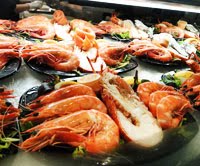
We were out on the street at the crack of dawn yesterday looking for a taxi to take us to our 6:55 am Sydney Fish Market tour. We found a genial driver who had 15 minutes before his next pickup who agreed to take us. That sounded great, except he didn't really have time to squeeze in the trip, so he drove like a maniac, lurching and swerving through traffic, cursing at the other drivers as we flopped around in the back seat like fish out of water. "Get out of the way, you bloody donkey", he yelled, "What? Are you driving to the sanitarium?".  It was half funny, half terrifying! Anyway, it was worth the hair-raising trip to get the backstage look at the second largest fish market in the world. A bit of perspective, though: in one day of the world's largest fish market (Tsukiji in Tokyo), more fish is auctioned than in two weeks in Sydney. Still, a thousand crates of seafood is sold per hour--crates of barramundi, tuna, dory, crabs, yabbies and more. The auctioning is in the Dutch style (which they have been using for generations in the tulip market). Seafood is brought in, assessed by the Market experts who set a price for each lot. Instead of lots starting low and being bid up, each lot starts at $3 per kilo over the assessed price and comes down, with the price displayed on a large screen with a circular "clock" counting downwards. As the price comes down, the buyers jump in at the price they want to buy. The next lot of the same seafood starts at $1 above the price the preceding lot. If the buyer waits too long, the seafood will sell out; if the buyer jumps in too early, they pay a higher price. We got to go down on the floor where the "whalers" move crates in to be inspected and out to the waiting trucks of the buyers. We saw "by-catch" fish like leather jackets which used to be thrown out by fishermen and are now salable food fish. In the old day, fishermen just took from the sea what they wanted and tossed out the rest. But, overfishing and overpopulation has meant the ocean systems are stressed and many fish are on the verge of extinction. More species are being utilized instead of being wasted. Also, Australia has taken a strong lead in the sustainability issue by instituting guidelines for the harvesting of its seafood. The use of 'by-catch' is one of the ways they control waste--by-catch used to be tossed out, now all seafood netted or caught on lines must be landed on the boat and used for human or pet food. Quotas are set for each species and fishermen have to buy a license for their portion of each type of harvest. Safeguards have been put in place, for example, eastern rock lobster females cannot be harvested when they have eggs; in Queensland, they cannot be harvested at all.  Also, each and every crate of seafood is inspected by Fish Market experts and graded. In the US, sadly, our seafood is inspected and graded in a very random, sporadic fashion, plus much of our seafood is from China where the quality control is questionable. Read this chilling USDA report: "Imports From China and Food Safety Issues". The premiere quality of seafood in Australia is striking--even fast food venues serve top quality fish. I had a "take away" plate from what looked like a fast food place at the Circular Quay called aptly, Quay Seafood, of barramundi with french fries. It was one of the best pieces of fish I've ever had, so fresh, just lightly dusted with flour and grilled perfectly. It was pricey, as everything in Sydney seems to be--$20, but it could have fed two people easily.
We marveled at the big tuna in the sashimi area--only line-caught, immediately chilled tuna can be sold as sashimi (or sushi) grade. The reason is that net-caught fish often sit on the deck of the boat for 3 hours or more as they are graded and sorted before going into the hold. Bacteria start to grow quickly in fish, so the fish is not as fresh as line-caught which can come off the hook and onto ice in less than a minute. Bluefin tuna, which may be put on the endangered species list due to overfishing, is the favored raw fish of the Japanese. It is so in demand, and now so rare, that a single bluefin can fetch upwards of $170,000. Bluefin fishermen usually have a helicopter ready to transport the fish immediately to the nearest airport where it is shipped on ice to the Tokyo Fish Market, where it arrives within 24 hours of being hauled in. Fortunately, there was sustainably harvested seafood available in the Markets' retail area and we had a seafood feast for breakfast.

6/17/10

Bush Tucker - Australian Wines and Food in the land of Oz

With great (unplanned) synchronicity, this week's Online Grapevine special features Australian wines, from K Wines's Marquis Philips label, in the week just before I fly "down under" to the land of Oz! Australian wines have made a big splash in the US in recent years, more about that later. But first, the most intriguing aspect of Aussie culture to me is bush tucker--"bush" meaning "the Outback" and "tucker" meaning "food". Bush tucker is the name for the huge variety of edible herbs, spices, mushrooms, fruits, flowers, vegetables, animals, birds, reptiles and insects that are native to the country and traditionally consumed by Aboriginal peoples. The list includes Witchetty grubs, bugs (relatives to crawfish), yabbies (relatives to lobsters), wattle (seed from acacia) and goanna lizards. No, I'm not a Andrew Zimmern-wannabe and I won't be eating wallabees or Witchetty grubs--though an anthropologist friend developed a fondness for them and claims they taste like Skippy peanut butter. But, I am fascinated by the diverse flora and fauna of the Land Down Under and will look forward to trying some of the endemic spices and seasonings. Aboriginal celebrity chef Mark Olive has a listing of native plants like kutjera (also called desert raisin or bush tomato) on his website, as well as recipes such as Smoked Crocodile Chicken Salad flavored with kutjera (pictured at left), sea parsley, salt bush and wattleseed. Bush tucker ingredients can be purchased online from the Bush Tucker Shop in Sydney which I hope to scout out. We also have tickets to see the Sydney Fish Market and (very difficult to obtain) reservations at Tetsuya's, so it should be a gustatory, as well as cultural, adventure!


SEAFOOD WITH MACADAMIA PESTO:
1 cup fresh basil leaves
1 cup macadamia nuts
2 cloves garlic, minced
1/2 cup olive oil
1/2 cup grated Parmesan cheese
4 fillets of mahi-mahi or striped bass, deboned (1 1/2 to 2 lbs.)
1 cup breadcrumbs
salt to taste
Preheat the oven to 375 degrees. Put the basil, macadamia nuts, garlic and oil in a food processor and whirl until well-mixed but still chunky. Transfer to a bowl and add the Parmesan and bread crumbs and mix well. Salt to taste. Press the pesto mixture into the fish on all sides, place on a greased baking pan and bake for about 10 minutes until cooked through or the internal temperature reaches 145 degrees. Serves 4.
Pair this recipe with the 2008 Marquis Philips Holly's Blend.

According to wineaustralia.com, Australia's first vineyards were planted in 1788 in a small area near the Sydney Harbour Bridge; the country now is the world's fourth largest wine exporter. The most famous winery is Penfolds which was established 60 years ago. Their wines command prices in the tens of thousands of dollars per bottle for certain vintages, like the 1951 Penfold Grange that sold for over $50,000. Founder Max Schubert started the first vineyard in Adelaide, New South Wales, but as the company grew and was bought out twice, their portfolio and vineyard reach has grown to include the Barossa Valley (the center of Aussie wine production), famed McLaren Vale south of Adelaide, cool Clare Valley (good for Riesling and Chardonnay cultivation), Coonawarra and more--all in the South Australia wine region. The map from the Grateful Palate Imports website shows the relationship. One can see from the Australian Bureau of Meteorology map that the rainfall is heaviest in the south and east (where the continent's only mountain range runs). Winemaker for Marquis Philips, Chris Ringland wrote this of the climate: "The weather in Southern Australia is profoundly influenced by one geographical feature; there is no land mass between Australia’s southern coasts and Antarctica...This means that when the center of a high pressure cell is located over the Southern coastal wine growing regions as it approaches from the West, we experience cool, wet conditions due to cold air being directed up from the South Polar regions. As the cell progresses across South Eastern Australia to the Tasman Sea, the subsequent northerly airstream directs hot, dry air down from central and Northern Australia."
Tidbits of information on viniculture from the Australian government wine website include a claim for the oldest vineyards in the world, since they escaped the vine disease phylloxera which decimated most of the vineyards in Europe and the Americas at the turn of the century.

6/10/10

Anthony Bourdain's Kitchen Confidential

Vegetarian-hater, foul-mouthed, pothead, sarcastic, raconteur extraordinaire--Anthony Bourdain is everything I'm not, and I should hate him for calling vegetarians "the enemy of everything good and decent in the human spirit, and an affront to all I stand for, the pure enjoyment of food" (which, by the way, includes eating unwashed warthog rectum). But I've enjoyed his Travel Channel show because I love to travel vicariously and I am entertained by/envy his globe-trotting adventures. I was actually unaware of his controversial bad-boy-chef reputation until I read "Kitchen Confidential", a hilarious Rabelasian read about his drugging days in rat-infested New York kitchens. He's sure to have made many enemies with his tell-all-and-spare-no-one style of defamatory writing and seems to have left a wreckage of closed restaurants behind him (including Les Halles, which was closed down by the health department). Yet he's charming and he's a remarkably talented writer. I just would never eat anything that came out of his kitchen. In "Kitchen Confidential", he talks about his fingernails: "My nails, such as they are--I gnaw them in the taxi home from work--are filthy; there's dried animal blood under the cuticles, and crushed black pepper, beef fat and sea salt...My fingertips are stained with beet juice (hot borscht as soup du jour yesterday), and if I hold my fingers to my nose, I can still smell smoke salmon, chopped shallots and a hint of Morbier rind." Really--he's never heard of a nail brush and copious amounts of soap and hot water? The rats were so bad at one place he worked: "The place was owned by a very aggressive rat population, fattened up and emboldened by the easily obtained stacks of avocados left to ripen outside the walk-in each night. They ran over our feet in the kitchen, hopped out of the garbage when you approached and, worst of all, stashed their leavings in the walls and ceilings. Every once in a while, the soggy, acoustic tile ceilings would crumble, and moist avalanches of avocado pits, chewed chicken bones and half-eaten potatoes would come tumbling out on our heads." But, he was the chef! He was culpable in preparing food in that type of environment. Yet, I still plan on reading his other books to revel in his descriptive prose. If I refused to read every author's whose opinion differed from mine, or whose private life was unsavory, I'd have a minuscule reading list. One doesn't need to live or work like Anthony Bourdain or Hunter Thompson to appreciate their writing!

Adapted from Urban Tavern in San Francisco by LA Times' writer Noelle Carter.
URBAN TAVERN'S SPICE-BRAISED PORK RIBS:
Total preparation time: 4 1/2 hours, plus overnight refrigeration and cooling times
Servings: 6 to 8
SPICE RUB:
1/2 cup fennel seeds
1/2 cup coriander seeds
2 tablespoons ginger powder
2 tablespoons ground nutmeg
1 tablespoon smoked paprika
2 tablespoons kosher salt
1 teaspoon black pepper
1/2 teaspoon cayenne powder
1. In a medium sauté pan heated over medium heat, toast the fennel and coriander seeds until aromatic, about 2 minutes. Remove from heat and cool completely.
2. Grind the fennel and coriander seeds to a fine powder using a spice mill or coffee grinder, then combine with the ginger, nutmeg, paprika, salt, black pepper and cayenne powder to form a rub.
3. This makes a generous 1 cup rub, and you may not use all of it for the final recipe. Store the rub in an airtight jar or sealable plastic bag in a cool, dark place up to 4 to 6 weeks.

BRAISED PORK RIBS:
2 racks pork ribs, preferably St. Louis-style, silverskin removed
Spice rub (from above)
1 cup apple cider
2 cups chicken broth
2 cups beef broth
2 bay leaves
Salt and pepper
2 1/2 cups diced apples, about 2 apples
2 1/4 cups diced onion, about 1 onion,
Scant 1 cup diced carrots, about 2 carrots
1 1/2 cups diced celery hearts, from about 1 bunch
1. Coat the rib racks generously on each side with the spice rub. Refrigerate, uncovered, overnight to season.
2. The next day, in a large saucepan, bring the cider, chicken and beef broths and bay leaves to a boil over high heat. Remove from heat and season with salt and pepper to taste.
3. Heat the oven to the broiler setting. Place the rib racks on a rack over a rimmed baking sheet. Broil the racks until browned on each side, about 2 to 4 minutes per side, depending on the heat of the broiler.
4. Reduce the oven heat to 300 degrees. In a large roasting pan, combine the diced apples, onion, carrots and celery heart, and place the seared ribs on top (pour any drippings from the rimmed baking sheet over the ribs). Pour over the hot broth.
5. Cover the pan tightly, first with parchment paper, then with a layer of foil, creating as tight a seal as possible. Place the covered pan in the oven and braise the ribs for 3 hours.
6. Remove the pan from the oven and cool the ribs completely. Skim the fat from the pan and set the ribs aside. Strain the braising liquid (we had about 1 quart) into a saucepan and bring to a boil over high heat. Reduce the sauce by half.
7. To reheat the ribs, place the ribs in a roasting pan and pour the sauce over. Place the ribs in a 325-degree oven and heat until the ribs are warmed through before serving.

Pair this recipe with the 2005 Corley Proprietary Red.

5/31/10

Japanese Food Wine Pairing -- Seasonal Flavors


In the '80s, the mini-series "Shogun" was a big hit. My father, who was Japanese, and Japanese friends had little regard for it due to the many inaccuracies and anachronisms it contained. Most glaring was the idea that a noblewoman could have fallen in love with one of the foreign men of that time. Cleanliness has always been a top priority for Japanese, they bathed every day and scrubbed their houses clean. Europeans in the 1500s rarely bathed, perhaps once a month if they were wealthy and once a year if they were poor. The streets in Europe ran with raw sewage and heavy perfume was used to mask body odor. The Japanese were horrified by the foreigners lack of hygiene and called them nanban: "barbarians".  Besides cleanliness, Japanese value visual harmony, artistry and simplicity; these values are reflected in their cuisine which is always presented as a feast for the eyes as well as the palate. Their art and culture revolve around the appreciation of nature and her seasons. Thus, the “haute cuisine” of Japan is kaiseki where the freshest possible seasonal vegetables, fruits and seafood are presented on exquisite dishes decorated with seasonal motifs in an elaborate service of multiple courses. If one has kaiseki in a traditional ryokan, one is served in one's room, a process that takes two to four hours. My daughter and I had the opportunity to sample kaiseki at the Hiiragiya Ryokan in Kyoto and the Kankaso Ryokan in Nara on a trip a couple of years ago which were highlights of the experience.

So, when I had the honor of having two chefs this weekend at my dining room table--Chef Skip and Chef Stephane Rapp of SBCC's Culinary Arts, I thought of making a Japanese-American version of kaiseki (non-traditional with homegrown and local ingredients).  I normally just drink green tea as it pairs perfectly with the traditional Japanese flavors and find sake' too sweet as there is already quite a bit of sweetness in most Japanese dishes. But, a grand occasion demanded fine wines. Fortunately, Paul Arganbright, president of Touring & Tasting brought a lovely bottle of the 2006 Bouchard Pere et Fils Corton-Charlemagne Grand Cru which we had learned about from the Henry Wine Group Trade Tasting. Its crisp, clean acidity was perfect with oysters on the half-shell with lemon/rice vinegar/green onion flavoring, dobin mushi (matsutake soup with black cod and kamaboko) and a seafood salad with crab claw, shrimp, tamago and red ginger and nasturtium flower.
A bottle of the 2006 Matthews Syrah, which had been a Touring & Tasting World Class wine club shipment, was perfect with the NY steak teriyaki, sake/citrus marinated grilled salmon, and white asparagus with roasted sesame/miso dressing. The Matthews Columbia Valley is a powerful blackberry and black currant Syrah with no rough edges. Japanese seasoning comes from the following five principle flavors: soy sauce, miso (a salty fermented bean paste), mirin (a sweet cooking sake), dashi (fish broth) and ginger. Soy sauce comes in different levels of saltiness and can be tempered with sugar for a softer flavor. Miso comes in two basic varieties—aka miso (red) and shiro miso (white), and is used for soups, sauces and marinades. Mirin is a sweet cooking sake usually used for teriyaki, sushi rice and salad dressing though the dryer drinking sake can be used for seasoning seafood. Dashi is used in all soups, including miso soup, and as the stock for boiling and braising. Ginger is minced to add spiciness to dishes or pickled for a salty/spicy relish. Secondary flavors are seawood—either wet or dry, sesame seed, and chili powder usually in a seven-spice chili mixture called togarashi. Aromatic white wines such as Viognier and blends with Semillion conflict with these flavors and oaked California Chardonnays are too "oily". The French white Burgundy was perfect with the fish dishes. If I have the opportunity in the future, I'd love to try it with sashimi! Strongly flavored dishes like teriyaki and ones flavored with aka miso need a smooth red; tannic wines like Cab clash. After tasting the Matthews Syrah with teriyaki, I would say it is the #1 wine pairing for all teriyaki dishes!
From St. Supery Winery, a family-owned estate winery in the heart of Napa Valley, recognized for outstanding Sauvignon Blanc, Cabernet Sauvignon and their Élu and Virtú blends:
GOAT CHEESE SOUFFLE':

3 tablespoons unsalted butter plus some to coat the ramekins
¾ cup Panko (Japanese breadcrumbs)
3 tablespoons all purpose flour
1 cup half and half
12 ounces fresh goat cheese
4 egg yolks
8 egg whites from large eggs
1 ½ teaspoons kosher salt
Pinch of white pepper
Preheat oven to 425 degrees and place the rack in the middle. Butter the bottom and sides of ten 4-ounce ramekins. Coat the ramekins with the Panko and tap out the excess.
Melt the butter in a medium saucepan, whisk in the flour and cook for 1 minute. Add the half & half, stir constantly, and cook for one minute or until the mixture thickens.
Place 9 ounces of the goat cheese in a large mixing bowl.
Pour the hot half/half mixture over and mix well. Stir in the egg yolks and season with salt and pepper.
Beat the egg whites to stiff peaks using a mixer. Gently fold the whites into the cheese mixture. Half fill the ramekins with the cheese mixture and divide the remaining 3 ounces of goat cheese equally among the ramekins.
Top with the remaining cheese mixture and sprinkle lightly with Panko.
Place the ramekins in a baking pan and fill with hot water to about half way up the sides of the ramekins. Bake for about 25 – 30 minutes or until the soufflés are golden brown. Makes 10 servings.

Pair with the 2006 St. Supery Virtu'.

In Colorado, where I grew up, we would have just planted our vegetable garden in May and tender plants would just be beginning to mature out of the tender baby shoot stage into vigourous "teen year" growth. In sunny Southern California, I planted my first summer vegetables in late April; tomatoes are already ripening. I gathered a precious harvest for yesterday's dinner. Minced onion mixed with goat cheese, panko and a bit of egg were wrapped in squash blossoms, coated with egg and fried in olive oil with onion and garlic flowers (the round white puffs left of the tomato in the photo), quartered artichoke and slivered green onion. The rest comprised a salad and the flowers decorated our table. Ahh, the joys of summer!

5/27/10

Tasty Tapas and Top Chefs Santa Barbara

I was seated next to beautiful young girl at last night's "Reaching For Stars" benefit for Noah's Anchorage, which provides support services for homeless and at-risk youth. It turned out she was the keynote speaker, having come from foster care to Noah's Anchorage. She is a remarkable young woman, poised and confident despite the hardships she had to endure on her way to Noah's Anchorage which currently houses and supports her in her quest to complete her GED and go on to nursing school. Our eyes were shiny with tears as the audience stood to applaud her courage and resilience. It was a wonderful evening, orchestrated by Chef Vincent Vanhecke, who assembled eighteen of the top chefs in Santa Barbara to donate their time creating a fabulous multi-course dinner (see full list of restaurants and caters represented). Chef Vincent downplayed the hard work he did to make it a sold-out success, saying "With so many chefs, there was a bit of friendly competition to see who could make the best dish, it was fun!" The chefs pulled out all the stops to wow the attendees, here's the menu :
Hors d'oeuvres 
Pollo Adobo Potstickers
Caprese Brochette
Arancini DiRiso Marinara
Italian Sausage and Grilled Artichoke Tart
 Lucas & Lewellen Brut Sparkling Wine
Brander Vineyards Sauvignon Blanc
Cottonwood Canyon Estate Chardonnay
Rusack Syrah
Chefs: Vincent Vanhecke, Don Skipworth, Mari Bartoli and Charlie Rushton


First Course

"Three Salmon Walked Into A Slaw" [three salmon/slaw interpretations]
Rusack Sauvignon Blanc
Fess Parker Chardonnay

Chefs: John Downey, Randy Bublitz, Alex Castillo
Second Course
Local Seafood Trio
Ridgeback Shrimp Ceviche with Tangerines, Limes and Micro Cilantro
Gazpacho with Halibut Tartar and Cerignola Olives
Grilled Sea Bass with Wild Arugula and Fennel Salad
Summerland Santa Barbara County Pinot Noir
Chefs: Brian Parks, Eric Widmer, John Trotta
Main Course

Braised Lamb Shoulder and Rosemary-Mint Char-Grilled Rack of Lamb
White Bean and Chard Ragout
[vegetarian option: a lovely, lemony risotto with micro-greens]
Zaca Mesa Syrah
Fess Parker Syrah
Lucas & Lewellen Merlot
Chefs: Brandon Hughes, John Pettitt, Jeff Magown
Trio of Desserts

Chocolate-Hazelnut Cake
Raspberry Dacquoise
Meyer Lemon Tart

Chefs: Christine Dahl-Hutchings, James Sly, Michael Hutchings


Honestly, ALL the dishes were delicious, but if I had to highlight a few I would say the salmon dish was a stand-out because of the way the three preparations of salmon and slaw were so different in flavor and texture, yet complimentary: one was a lightly battered soft salmon chunk on a crispy slice of toast, the next, a salmon ceviche spiced with chili and cilantro with cool, creamy, contrasting avocado, and the last, a spring roll with the salmon and slaw wrapped inside. The ingenious plating had a sheet of black nori as the base which (though my photo is not the best) made a dramatic contrast with the white plate and colorful food. The Rusack and Zaca Mesa Syrah were excellent and the Raspberry Dacquiose and Meyer Lemon Tart were divine--delicately flavored and light on the palate--a perfect end to an extraordinary meal. We had the chance to chat with Chef Stephane Rapp of the SBCC School of Culinary Arts and student Pegeen (winner of the SBCC "Edible Books") who were not credited on the menu, but came to give a hand in the kitchen. Kudos to all!

Wine Pairing Recipe
Eggplant Tapas:
4 small Japanese eggplant
salt
3 Tbsp. olive oil
4 Tbsp. minced onion
4 garlic cloves, minced
1 tsp. cumin
1/2 tsp. chili flakes
4 Tbsp. minced red bell pepper
1 egg
1 lb. lean ground beef
1/4 cup dry bread crumbs
1/8 tsp. black pepper
spray olive oil
Select Japanese eggplants rather than the larger traditional eggplants as there size is better for tapas and their skin softer when cooked. Cut the ends off the eggplant and remove the core, using an apple corer. Hold a cored eggplant in the palm of one hand and sprinkle salt inside using the other hand. Cover the top end with your other palm and shake the salt inside to coat the interior of the eggplant. Shake out excess salt and put the eggplants on end on paper towels to drain for 20 minutes.

Preheat the oven to 350 degrees. Sautee the onion, garlic, bell pepper, cumin and chili flakes in oil until the onion is translucent. Set aside to cool. In a mixing bowl, stir the egg, then mix in the ground beef, bread crumbs, black pepper and the onion/garlic mixture. With a sharp knife, make lengthwise slits in the eggplants, starting one inch from one end and ending an inch before the other. Carefully stuff 1/4 of the meat mixture into each eggplant. Place in an oiled baking dish. Spray the eggplants with oil, cover and bake for 35-45 minutes or until the internal temperature has reached 165 degrees and the meat is well-cooked.
Serves 4.

Tomato Sauce:
4 Tbsp. olive oil
1/2 cup chopped onion
2 cloves garlic, minced
1 tsp. chili flakes
2 1/2 lbs. fresh tomatoes, peeled, seeded and chopped or 1 28 oz. can of crushed tomatoes
1 tsp. paprika
1/8 cup red wine
salt and pepper to taste
In a large saucepan, saute the onion, garlic and chili in the oil until the onion is translucent. Add the tomatoes, paprika and red wine and simmer over medium low heat for 30 minutes, stirring occasionally. Salt and pepper to taste.

Pair this tapas recipe with a rich red from Spain, such as the 2009 Tarima Monastrell or 2009 Venta Morales Tempranillo.

5/19/10

Visual pleasure! ... beautiful food shots

LAST WEEK CULINARY CLASS:
Whew! Finals are over and I'm free for the summer. Thanks to our teacher Chef Vincent van Hecke, who besides being a great instructor, also takes beautiful food shots. Here's a sample of his food photography of our "Modern Food: Style/Design/Theory" class:


This week's wine pairing recipe:
Give your pocketbook a break this week! Save money on wine with our half price wine sale  and with this week's wine pairing recipe. Tofu has 11 grams of protein per half cup serving but costs only around 40¢ per serving. Plus it's calcium-rich!

TOFU PAPRIKA WITH BUTTERY HUNGARIAN DUMPLINGS:
TOFU PAPRIKA:
1/2 cup minced onion
2 Tbsp. butter
1 clove garlic, smashed or minced
1 Tbsp. tomato paste
1 tsp. paprika
1 cup broth (vegetable or chicken)
1/2 cup sour cream
1/2 tsp. flour
salt and white pepper
chopped parsley (optional)
1 cake firm tofu, cut into cubes (14 oz. container)
Saute' onion and garlic in butter until the onion is translucent. Add the paprika and tomato paste and cook another minute, stirring to mix. Stir in broth and bring to a boil. Mix the sour cream and flour in a separate bowl, then add to the sauce and cook for several minutes, stirring, until the sauce is thickened and smooth. Taste and add salt and white pepper if desired, to taste. Stir in the tofu and simmer for ten minutes or until the tofu is heated throughout. Spoon over dumplings and sprinkle with parsley if desired. Serves 4.
GALUSKA (HUNGARIAN DUMPLINGS):
1 1/2 cups flour
1/2 cup water
3 tsp. salt + 2 Tbsp. salt
4 Tbsp. melted butter in two parts
Sift the flour and 3 tsp. salt together. In a separate bowl, mix 2 Tbsp. of the melted butter (at room temperature--not hot as it will cook the egg) and the egg. Mix in the water. Stir the dry ingredients into the liquid and mix until the dough just comes together. Do not beat or knead it. Set aside for one hour in a cool place, with a damp towel over the top of the bowl. Boil a large pot of water, salted with 2 Tbsp. of salt. With floured hands, pull off small pieces of dough--about the size of a nickel and drop into the boiling water. Cook until the dumplings rise to the top of the pot, about 10 - 15 minutes. Scoop out the dumplings as they are cooked and place them in a bowl with the remaining 2 Tbsp. of melted butter. Stir to coat the dumplings with butter and use as a base for the tofu paprika.

Enjoy this tofu dish with a glass of a white Rhone blend, such as the 2007 Edward Sellars Blanc du Rhone.