10/21/10

The Gentrification of The Land And How Exports Shape Rural America

Photo George Naylor --Farm Bill Basic

In the 1980s, a crisis hit farmers hard. A loosening of export policies in the '70s allowed huge grain exports to the hungry Soviet Union, jacking up commodity prices. Removal of restrictions on lending by our Federal Land Bank led to a boom in farmland prices and ballooning debt. Like the speculative real estate boom prior to the mortgage crisis we face today, farmland in the '80s experienced a bubble, which popped when the oil embargo sent interest rates soaring into the double digits. Family farms, some held for generations, had to go on the auction block as families across the Midwest declared bankruptcy.

Domestic and alcohol abuse and suicide rates jumped and some farmers broke under the pressure. In Iowa a farmer killed his banker and wife, then himself. In Minnesota a farmer and his son killed two bankers. Small towns in rural areas went into decline as the population moved away to find employment; many never recovered and now are ghost towns.

I was thinking of this as I took the drive from Santa Barbara north to Monterey along Highway 101 last weekend. I spent a great deal of time driving this route in the '90s to Paso Robles. After the cluster of Andersen's Pea Soup, hotels and gas stations at the junction with Highway 246, there was a seemingly endless drive through brown rolling hills devoid of anything except a few native coastal oaks and some cattle in widely spaced fenced pasture. It was a two color, two hour drive--just brown land and blue sky, except for two or three brief months when the former turned green with spring rains.

Star Lane Vineyard, Santa Ynez
Two decades later, the land looks positively pastoral. Green blocks of grapevines rake across the hills, festooned with sparkly strips to shoo the birds from the fruit. Winery signs punctuate the edges, and grand establishments can be glimpsed among hills, now verdant year round. We witnessed the same in our trip to the Willamette Valley where the transformation is even more noticeable. Old, worn stores and restaurants with their paste-on letter signs missing parts of words and light-up marquees, ringed now with only a few working bulbs, are cheek-by-jowl with shiny glass, brushed concrete and steel restaurants, bakeries and gourmet cheese shops.

What has happened is stupendous in its implications for rural areas: in 1995, there were only 944 wineries in California, now there are nearly 3000. In Oregon, there were 71 in 1990 and over 400 today.
Read through the biographical information on winery owners and you'll find individuals successful in other careers who had the big bucks necessary to establish their own winery: actors like Fess Parker, lawyers like Bob Hartenberger of Midnight Cellars, corporate executives like Lisa Pretty of Pretty-Smith or bankers like Selim Zilkha of Laetitia. With wineries has come a welcome infusion of capital into rural areas, as wineries need a support system: hotels for tasting room aficionados, gourmet restaurants, vineyard and winery employees, winemaking supply companies, schools for the children of the new residents, internet service...the list goes on and on. The business of wine has revitalized rural areas and given winemaking states a huge economic boost. Exports have played an enormous part of this growth. In 1995, the U.S.A. exported about 143 million liters of wine overseas, in 2009 over 413 million liters were exported. The economic impact on California by the wine business is estimated to be over $51 billion and over $103 billion on the US economy. So, the next time you enjoy your glass of wine, give a toast to yourself for helping to boost our rural areas and contribute to American jobs!

This week's wine pairing recipe!
BEEF EN CROUTE:
2 lbs. beef fillet or top rump roast
Salt and pepper
1 lbs. frozen puff pastry
4 Tbsp. semolina flour
2 egg yolks + 2 Tbsp. warm water
3 Tbsp. olive oil
1 Tbsp. garlic powder or 2 cloves of garlic, diced fine
2 Tbsp. powdered thyme
Dijon mustard or horseradish sauce, as condiment

Preheat the oven to 400 degrees. Sprinkle the beef on all sides with salt and pepper. Heat the oil in a heavy frying pan and sear the meat on all sides. Transfer to a baking pan and put into the oven for 10 minutes for medium rare, 20 minutes for medium, 30 minutes for medium-well or 40 minutes for well-done. If you like your meat rare, don’t put it into the oven and skip this step. When roasted to the desired doneness, remove from the oven. Let the meat sit and cool for several minutes.

In the meantime, set out the puff pastry to thaw. Stir the egg yolk and water in a small bowl. Mix the garlic, semolina flour and thyme together and rub all over the meat. Roll out the puff pastry to about 1/4" thickness. Lay the beef on top and drape the puff pastry around it, brushing egg yolk on the "seams" so the pastry will seal and cutting off excess with a sharp knife. Try and get the main seam under the beef, and tuck the ends underneath. You can use a cookie cutter to make decorative shapes with the remaining pastry--attaching with some egg yolk. Brush all over with the egg yolk mixture, and return to the baking pan and oven to bake for 30 minutes or until pastry is golden brown.

Let the beef sit for 10 minutes after removing from the oven before slicing and serving. Serves 4. Pair with a powerful California Cabernet Sauvignon.

10/8/10

Old MacDonald at Bandon Dunes, Oregon

Lodge with Bandon Dunes Course behind, then the ocean.
Part of the 32 acre practice area
Bandon Dunes Golf Resort opened in 1998 on the spectacular, wild coast of Southern Oregon after the Scotsman David McLay Kidd spent three years getting to know the land and designing the first course, Bandon Dunes. Pacific Dunes, designed by Michigan architect Tom Doak opened in 2001, and four years later was named the best golf course in the U.S. by Golfweek Magazine, putting it ahead of Pebble Beach. Now, there are four unique 18 hole courses, with the inland Bandon Trails added in 2005 and Old MacDonald in 2010, which is rated #10 out of the top 100 courses by golf.com, plus a two enormous driving range with unlimited balls for guests, a six hole practice course and apparently another course under development. The resort is lovely and treads lightly on the land with wildlife in abundance. We were looking for Fred, the porcupine we heard lived outside our porch, but only saw many sweet-faced deer grazing just steps from the door and on the fringes of the courses.


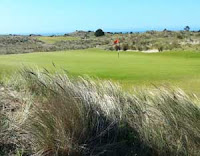
We played Bandon Trails the first day, the employees' favorite and the only one not on the water, though we did get some ocean views. It's more protected and proved to be an excellent choice on the first day when there was wind for the other three courses. The first photo is a look at the carry on one of the men's tees--the triangle in the center of the photo is the fairway and green.


Hole 7 has a nasty elevated green, with sloping sides on all sides, this side shows a deep bunker waiting to snare any balls that don't land within the green's small center. I had a bad time and took an 8 here.
I think this was hole 10 where my tee shot landed to the right of the fairway and this was my view to the pin which you can barely see on the right side of the green. Of course, I managed to get in the sand but luckily managed to chip out and onto the green. At this point I already had sand in my shoes and hair, so was getting used to it!
Looking back from the 18th green, ocean in distance.

Old MacDonald was my first experience playing links golf and I loved it! The fairways are hard and tight and the balls roll forever. The greens are almost indistinguishable, just mowed a bit shorter. The wide fairways are deceptive in that the course looks easy, but it is laced with bunkers that are either incredibly deep (often 10 ft. high on the greens side) or impossibly huge. Also, the greens are enormous and undulate. Our wonderful caddie Shane said that they hid elephants under the greens and they do look that way--with enormous bulges and ridges and valleys.
 I was at the lip of this bunker from hell and tried to chip up to the green (pin just out of the shot on the right) but flubbed and ended up in the sand again and couldn't get out. I was so nervous on the front 9 of this course due to being paired up with some big shot golf course owner that I just picked up my ball on this hole so I wouldn't slow down the pace of play.
Hole #5--Paul hits a smooth wedge shot on this par 3 and gets a hole-in-one! His first in 40+ years of playing golf. A great achievement on a beautiful course on a day with perfect weather. A day to remember!


 A great view just before making the turn--not a bad place to get a lemonade and soak in the scenery.


This was one of my few triumphs--it doesn't look so steep, but this was an uphill hole with two bunkers and I managed to get into both of them. My tee shot went into the first, I hit it into the second, somehow managed to chip it up to the green and had one putt for a par 4!

Thanks to awesome and encouraging caddie Shane, I managed to loosen up and start hitting the ball better on the back 9. On 18, he handed me my hybrid which I swore never to use again, and essentially said "trust me!" I hit two good fairway shots with it and made a long putt to make par!
If we're fortunate enough to return to Bandon Dunes Resort, the next time we'll play Pacific Dunes and Bandon Dunes courses. By the way, the food is excellent at all the of the venues and the sweet potato fries are the best I've had anywhere.

10/6/10

On The Great Oregon Wine Trail

Sunrise over Willamette Valley from Black Walnut Inn

WEEK #6 WINE CLASS:

I'm playing hooky again from the Culinary School wine class, visiting Oregon to help find unique, artisanal wines for the Touring and Tasting wine clubs. Well, truth be told, it's more "r and r" with wine tasting, golf and Shakespeare, but we're getting a brief look at the terroir of Oregon and getting to sample some nice wines. Perhaps our visit can help you plan a wine country trip to the area. The photo at left is taken from the balcony of the very plush Black Walnut Inn, that sits on top of the Dundee Hills with a panoramic view of the Willamette Valley.

The Oregon Wine Board has a comprehensive site packed with information. If you look at their map, you'll see the four main viticultural areas:
  • Willamette Valley,
  • Eastern Oregon 
  • Southern Oregon
  • Columbia Gorge
Fine Oregon wines are finding international recognition, particularly Pinot Noir and Pinot Gris from the Willamette Valley, which is of the same latitude as France's Burgundy, with the cool growing season needed for the temperamental grapes. Thin-skinned grapes, Pinot Noir, and its "cousin" Pinot Gris, are  prone to mildew, rot and disease. It takes a brave vineyard manager to grow them, but the rewards are gratifying. Black Walnut Inn's 2007 Dundee Hills Pinot Noir is a good example, with aromas of violets and roses and a ripe cherry flavor. The Dundee Hills AVA lies at the heart of Willamette Valley and is the result of basalt lava flows in the Miocene. The red "Jory"soil is brick-red, silty, clay loam and produces brillant, structured wines with good minerality. The terroir is also expressed well in the Lange Estate Winery and Vineyards wines.

Exploring Wine* states: "Pinot Noir is a very finicky grape that defies definition when it comes to style and expectation in the finished wine. Pinot Noir celebrates both its sense of place and the human touch; depending on where it is grown and who is growing it, this varietal may produce a wine very unlike its nearest neighbor or the most distant vineyard".  A tasting at Trisaetum, in the neighboring Ribbon Ridge AVA, proves the above assertion by producing Pinot Noirs in a completely different style, not only from its neighbor, but from the different blocks of its Estate vineyards.

We had a lovely time with Margie Olson, owner of Torii Mor Winery, along with her husband Donald. Their vineyard is perfectly situated on the south side of the Dundee Hills, with great sun exposure and breezes, and thick Jory soil sitting on basalt--the grape roots reach 30 feet and more down into the bedrock for a nice minerality. Besides great terroir, they have artesian water (some of which they bottle), a panoramic view of the valley and Mt. Hood beyond and LEED (Leadership in Energy and Environmental Design) GOLD Certification from the U.S. Green Building Council. A little bit of paradise on earth! In addition to brillant Pinot Noirs, Torii Mor also produces Pinot Gris, Syrah, Viognier, a Rhone blend and a port. Margie had just returned from a very successful trip to Las Vegas where their wines were placed in many restaurants, including the Bellagio.

We also enjoyed the view and terrific wines at Winderlea Vineyard and Winery with one of the owners, Donna Morris. Their sustainably built winery is familiar from Sunset Magazine and their wide-open balcony was crowded with noisy customers enjoying their wine tastings. Winderlea Pinot Noirs and Chardonnays can sell out quickly, understandable given their character and finesse.


2010 has been a difficult vintage in Willamette with a cloudy summer and cool temperatures. We heard that vineyards had to be aggressively farmed this year, with both grapes and leaves thinned to allow the remaining grapes more sun to aid in ripening. Grapes in most vineyards are not pulled yet as the sugar level is not quite up and showers are forecast starting tomorrow. You can almost feel the tension in the winemaking community as they hope for one last spell of sunshine so they can bring in their grapes before the real rains begin. The bright spot is that the flavor of the grapes has already developed--we had a taste of them off the vine--so this 2010 vintage may be stellar, despite the anxious wait for harvest.

THIS WEEK'S WINE PAIRING RECIPE:
You can enjoy this tasty treat at the lovely Brookside Inn centrally located in the wine country of Willamette Valley, surrounded with acres of waterfalls and gardens, or make it at home and enjoy it with a chilled glass of the 2009 Rex Hill Pinot Gris.
BROOKSIDE INN POLENTA CAKES WITH GOAT CHEESE, SALMON AND POACHED EGG:
4 Tbsp. butter, in two parts
1 bunch scallions, chopped
1 -2 ears fresh sweet corn on the cob (or 3/4 cup frozen)
3 cups water
3/4 cup course ground corn meal
4 oz. goat cheese
3 Tbsp. Herbs de Provence, in two parts
4 Tbsp. sour cream
8 eggs
8 slices cured salmon
The night before, brown the corn, scallions and 2 Tbsp. Herbs de Provence in 2 Tbsp. of butter. Set aside. Put 3 cups water in a pot and bring to a low boil and slowly whisk in the corn meal. Cook over low heat for 20 minutes, stirring frequently with a wooden spoon. Stir in the corn/scallion mixture and the goat cheese. Spoon into 8 individual tart pans and refrigerate overnight.
The next morning:
Remove the polenta cakes from refrigerator and allow to warm to room temperature. Melt the other  2 Tbsp. of butter in heavy skillet on medium heat and brown the cakes in the butter.
Serve topped with a poached egg, cured salmon and a sour cream garnish. Sprinkle with the remaining 1 Tbsp. Herbs de Provence. Serves 8.
* Culinary School class text: Steven Kolpan, Brian H. Smith and Michael A. Weiss, "Exploring Wine" Third Edition, (The Culinary Institute of America).

9/29/10

White Wine Varietals

Test your wine knowledge! Answer this week's question: What is the second most planted white wine grape in California? (answer at end) 
WEEK #5 WINE CLASS:
Versatile and responsive to the winemaker's touch, the Chardonnay grape is the most planted world-wide, as it is easier to grow than most and can tolerate a wide range of soils and climates. Chardonnay wines range from agreeable jug wines produced from abundant vines to the finest wines brought to perfection by careful hand-thinning and labor intensive vinification. Three of the subregions in France's famed Burgundy AOC produce extraordinary wines from the grape: Côte de Beaune, Chablis and Mâconnais. But, Chardonnay from California has been steadily gaining world-wide acclaim and for good reason. The grape was our focus this week in class and our tasting was especially interesting because we had four wines to compare, instead of the usual two: a value Chardonnay from the Central Valley, two French white Burgundies, and a Sonoma Coast AVA Chardonnay.
  • 2008 Fevre Estate from Chablis is made by Bouchard Père et Fils with hand-harvested grapes. Wine Spectator gave this wine 90 points. It had the hallmark acidity and green apple flavor of French Chablis with minerality and a taste of wet stone. 
  • The 2008 Christophe Cordier Macon-Charnay "Vieilles Vignes" from Mâconnais was also brightly acidic with a strong vanilla oaked flavor, plus peachy fruit. 
  • The 2009 McManis Chardonnay is a $10 bottle of wine with "California" rather than vineyard-designated grapes, and without the intensity of the other more expensive wines, but a reasonable expression of the varietal, creamy from maloactic fermentation. Made by a family owned winery. 
  • The class loved the 2008 Fog Dog that I brought for us to try, from the Touring and Tasting's cellar. (Insider note: Touring and Tasting has a "secret cellar" of wines not in the online store plus can often procure a wine you request. So call Shannon at (800) 850-4370 ext. 100 if you're interested!) The Fog Dog displayed everything that makes (in my mind) California wine so superior. It's not just patriotism--grapes find their fullest ripeness under the California sun.  The resulting fruit balances the acidity that develops from coastal fogs. The Fog Dog Chardonnay is from artisanal, biodynamically farmed Freestone Winery in the Sonoma Coast AVA, on the border of the Russian River. The wine was big, buttery and perfectly balanced with a long silken finish and aroma of honeysuckle.
The Sauvignon Blanc grape is "green": flavors of green apple, green herbs, bell pepper and green fruit like lime, kiwi and honeydew melon are characteristics, with tropical fruit flavors developing in California wines. It thrives in France's Loire Valley and in Bordeaux, where it is often blended with Sémillon, and sometimes intentionally infected with "noble rot": the mold botrytis cinerea to make very sweet, extracted wines. In California, Sauvignon Blanc loves the cool north coast of Sonoma, Napa and Mendocino County which produce refreshing, crisp wine that pairs well with spicy foods. It's a great choice for one of California's favorite cuisines--Mexican! Robert Mondavi coined the term "Fumé blanc" in the 1960s for his bottling of the varietal. You can sample two Napa Valley Sauvignon Blancs in this week's Online Grapevine special.

Similar in DNA profile to Pinot Noir, the Pinot Gris grape is called Pinot Grigio in Italy and California, and can range in style from the big, full-flavored, full bodied wines from Alsace, France to the lighter bodied, crisp wines from coastal California, often redolent with citrus. Pinot Gris can be vinified, bottled and on the shelf ready to drink in just a month to 3 months.
Answer to our wine question: According to the latest USDA National Agricultural Statistics Service report, in 2009 90,434 acres of California farmland was planted to Chardonnay for winemaking, 24,772 to Colombard, 14,670 to Sauvignon Blanc, 8,676 to Pinot Gris.
What is Colombard? It is an easy-to-grow grape, mostly impervious to problems like rot. It develops fruit in abundance, producing up to 10 tons an acre (compared to some grapes that are kept below 1 ton per acre to maximize quality and flavor). It is used to give structure and a citrus flavor and aroma to "jug wines": simple, inexpensive wines often sold in boxes or large bottles.

9/22/10

September is California Wine Month

Forty years ago the world looked down its nose at American wine; today we have equalled or surpassed, in quality and reputation, countries with thousands of years of wine-making history. Americans are amazing! California has been at the forefront of this meteoric rise, ever since California wines stunned the world by beating French wines in the famous 1976 Paris Tasting. Sample a selection of red wine from the best of California and SAVE 50% with this week's Online Grapevine! 

 The first wine in California was produced in the chain of Spanish missions, initiated in 1769 by Father Junipero Serra, that extended 650 miles along the length of of the state. Later, as European immigrants, used to drinking wine with daily meals, came to the New World, many small home vineyards were established. Winemaking flourished during the Gold Rush, then was nearly eliminated between 1919 and 1933 with Prohibition. The years immediately after Prohibition saw the growth of cheap jug wine, but fine winemaking techniques and careful vineyard practices began to take place at wineries like BV, Souverain, Heitz and Mondavi, among many others. Choice soils, climates, and viticultural practices in California led to their domination in the 1976 Paris Tasting where the 1973 Stag Leap Cabernet Sauvignon won in a blind tasting over the 1970 Château Mouton Rothschild Pauillac Bordeaux, considered France's best red wine. The 1973 Château Montelena Chardonnay from CALIFORNIA won over the 1973 Domaine Roulot Mersault-Charmes Premier Cru. Investment and talent poured in, with the resulting explosion of great wine from Napa cult Cabs, to world-class Santa Barbara and Sonoma Pinot Noir, to award-winning Zinfandel (which many consider the quintessential American varietal) to...well, I think you get the point. American hard-work and innovation transformed our wine industry, so pour yourself a glass of California wine and toast to our success!
WEEK #4 WINE CLASS:
I missed wine class, but had the chance to try some hand-crafted wine in Santa Cruz. We had a lovely dinner at Christopher's on Lincoln in Carmel. The restaurant is casually elegant, with lovely food--nicely plated and delicious. The owner/chef came around to every table to chat with the diners, the waiter was not only humorous and affable, but very accommodating to my many culinary preferences. We had a crispy chili relleno stuffed with goat cheese, a marvelously light wild mushroom soup, freshly made pasta with seafood and a delicate tomato sauce, and my boyfriend had Muscovy duck with raspberry sauce. We tried the Cima Collina Hilltop Ranch Pinot Noir--made in Monterey by winemaker Annette Hoff--with rich flavors of berries and a bit of smoke and spice. We had a gourmet meal at a very reasonable price--I highly recommend Christopher's!
At Hoffman's Bistro and Patisserie in Santa Cruz, we had a salmon salad with a glass of the 2008 Ridge Lytton Springs Zinfandel--bold enough to match blackened salmon. Ridge Winery is in the Dry Creek AVA of Sonoma County, which has the cool mornings and hot afternoons to grow amazing Zinfandel redolent of cherries, berries and spice. Hoffman's was having a 50% off special that night, so we were able to taste the marvelous Lytton Springs Zin for just $18 for the half bottle!

From Shannon Ridge Vineyards and Winery, a recipe to pair with their 2007 Shannon Ridge Ranch Collection Zinfandel. Country-style ribs are slow cooked on the grill, then slathered with a spicy, sweet, citrusy BBQ sauce for a mouthwatering meal to complement their full-bodied Zin.
ORANGE PORK RIBS:
Pairs well with: Shannon Ridge Zinfandel
4 pounds pork country style ribs, individually cut
1 6-ounce can tomato paste
1/2 cup brown sugar
1/4 cup frozen orange juice concentrate, thawed
2 tablespoons red wine vinegar
1 tablespoon mustard
1 tablespoon Worcestershire sauce
1/2 teaspoon pepper
Combine everything except the ribs in a bowl and mix. Prepare grill for indirect grilling. Place ribs on grill and cook for about 60 minutes [turning occasionally to cook evenly]. Brush with sauce. Continue grilling until done. A couple of minutes before you remove the ribs from the grill brush on a heavy coating of the sauce. Watch ribs carefully to avoid burning.

INTERESTING CALIFORNIA WINE FACTS:
  • If California was a country, it would be the fourth largest producer of wine in the world
  • Over half the AVAs (American Viticultural Areas) in the U.S. are in California (107 out of 199)
  • Napa Valley was NOT the first AVA; the first was Augusta, Missouri. Napa was the second designated AVA, in 1983.
  • Sales of Pinot Noir jumped 45% during the year after the movie "Sideways", set in Santa Barbara County, was released.
  • The vast majority of California's 4,600 vineyards and 3,000 wineries are family-owned and operated.
  • More than 110 varieties of wine grapes are grown in California.
  • The California wine industry generates 820,000 U.S. jobs.

9/16/10

The Greatest Vintage Bordeaux Has Ever Produced

Was the year 2000 "the greatest vintage Bordeaux has ever produced"? According to a CNN report, the critics think so: "Wine critics tend to be a notoriously demanding bunch, but if you read what they're saying about the 2000 vintage in Bordeaux you'd think they'd tasted heaven itself. Wine Spectator's James Suckling claimed that it's "the first exceptional year for a new generation in Bordeaux. Uber-critic Robert Parker has gone so far as to call it "the greatest vintage Bordeaux has ever produced."  The Independent reported that the weather was perfect, with a dry August "Août fait le mout, as they say (August determines the character of the grape juice)", allowing Cab and Petit Verdot in particular to ripen beautifully. Plus, the harvest was dry and the grape pick was nearly perfect with few stems and leaves. Touring and Tasting was asked to help "liquidate" a private wine collection of vintage French wines, including several bottles of Bordeaux from 2000. See the two Bordeaux orders available now--try this acclaimed vintage at an affordable price!
WEEK #3 WINE CLASS:
Wine class last week was enlived with Antonio Gardella's poetic passion for wine. A student asked about his experience tasting wine from the venerable Château Pétrus: "It's like a woman in a diaphanous dress with beautiful legs, ample and generous--who says yes." Bordeaux is the source of most of the wine world's most expensive bottles. In fact the highest price ever paid for one bottle was $160,000 for a 1787 bottle from Château Lafitte once owned by Thomas Jefferson, now housed in the Forbes Collection (article in Forbes). Why the acclaim for Bordeaux? Certainly part of it is in the clever marketing of futures that drives the wine prices up, but one has to credit winemaking expertise honed for hundreds of years, the ideal climate moderated by the trio of rivers (Garonne, Dordogne and Gironde), and the remarkable soil--gravel pockets in silt and clay on the Left Bank and marly limestone hills of the Right bank. The gravel of the Left Bank, along with protective pine forest, keeps the temperature warmer, best suited for Cabernet Sauvignon grapes which need the warmth to ripen properly. Faster-ripening Merlot favors the Right Bank soil and climate. All areas of Bordeaux use judicious blending to maintain consistency and optimize their wine despite variance in the quality of the individual grapes. I meet many people in the US who think that wines that are 100% of one varietal are preferable, which I don't understand since great wine has been blended for generations. The only grape varietals allowed in Bordeaux are: Cabernet Sauvignon, Merlot, Cabernet Franc, Petit Verdot, Malbec and Carmenere. Antonio explained that Carmenere is rarely seen any more since Carmenere didn't take well to grafting to American rootstock after phylloxera decimated European vineyards in the 1860s (read article). Old Carmenere bineyards can be found in Chile because the soil is sandy and dry, conditions unfavorable phylloxera, as well as newer vineyards in Washington State with similar soil.

An interesting bit of wine information pertains to the mold botryitis cinerea or "noble rot" that causes grapes to partially "raisin-ize" meaning the flavors will be stronger--more extracted and the brix or sugar content elevated. It's difficult to control because other molds will cause off-tastes and keeping them out of the vineyard is difficult when spores float through the air. Growing noble rot is very labor intensive. At
Château Pétrus, the grapes are individually picked when the botryitis is optimum. They were also one of the first to practice green harvest or éclaircissage where some unripe grapes are removed to enhance the flavor of the ones that are left to ripen.


Recipe from Williams Sonoma.
BRAISED SHORT RIBS:
4 lb. bone-in beef short ribs
salt and freshly ground pepper, to taste
2 cups all-purpose flour
3 Tbsp. olive oil, plus more as needed
2 large yellow onions, chopped
3 large carrots, peeled and cut into 1-inch chunks
4 garlic cloves, chopped
1 cup red wine
1 can (6 oz.) tomato paste
3 fresh thyme sprigs
2 fresh rosemary sprigs
1 bay leaf
1 to 2 cups beef stock
Season the short ribs with salt and pepper. Spread the flour out on a rimmed baking sheet. Dredge the ribs in the flour, shaking off the excess. In a Dutch oven over medium-high heat, warm the 3 Tbs. olive oil until nearly smoking. Working in batches, brown the ribs on all sides, about 10 minutes total. Transfer to a slow cooker.

Add more oil to the Dutch oven if needed. Reduce the heat to medium, add the onions, carrots and garlic and cook, stirring occasionally, until soft, about 10 minutes. Transfer to the slow cooker. Add the wine to the Dutch oven and cook, stirring to scrape up the browned bits. Add the tomato paste, thyme, rosemary and bay leaf, mashing any large chunks of tomato paste with a spoon. Increase the heat to medium-high and cook until thickened and reduced by half, 8 to 10 minutes. Add the wine mixture to the slow cooker along with enough stock to come halfway up the sides of the ribs. Cover and cook on high for 6 hours according to the manufacturer?s instructions, stirring occasionally. Skim the fat off the sauce. Discard the herb sprigs and bay leaf. Transfer the ribs, carrots and sauce to shallow bowls or plates and serve immediately. Serves 6. Pair this recipe with one of our 2000 Bordeaux.
If you didn't take the Test Your Wine Knowledge quiz on Bordeaux, you probably aren't signed up for the free newsletter with wine discounts and recipes that I put out every week for Touring & Tasting--sign up here (no obligation to buy wine). Here's the quiz:
1. Is Bordeaux a type of grape, such as Merlot or Cabernet Sauvignon?
2. What is the difference between "Left Bank" and "Right Bank" Bordeaux?
3. What was the highest price ever paid for a bottle of Bordeaux?
  a. $4, 450
  b. $6,000
  c. $25,000
  d. $160,000
4. Does mold on grapes ruin them for winemaking?
5. What vintage of Bordeaux is called "the greatest vintage Bordeaux has ever produced" by famed wine critic Robert Parker, Jr?
You should know the answers from the post above!

9/8/10

Wine Terminology And Why It Matters To You

WEEK #2 WINE CLASS:
"Estate-grown", "hand-picked", "bio-dynamic", "new oak"...these are some of the terms you may find in a wine's description. But, do they signify something significant or are they just catchwords for people who enjoy the minutiae of viniculture?  Chef Randy Bublitz explained to our class how these terms make a difference. Our teacher Antonio had an important winery event, so we were fortunate to have the head of the School of Culinary Arts as our substitute. Besides being well-versed in wine knowledge as an experienced chef, he also taught the wine course in the years prior to Antonio.
USEFUL WINE TERMS:
Green harvest (French: vendange vert): removing some of the immature green grapes during the growing season, to reduce the yield, since smaller yields produce more extracted wine. It is a labor-intensive practice and indicates great care on the part of the vineyard manager/winemaker.
Hand-picked: just like it sounds--the opposite is machine-harvested. Obviously, picking by hand allows judicious choice by the human harvester on which grapes to keep and discard. Machine harvest takes all the grapes--ripe, as well as the odd ones that are unripe and overripe.
Estate-grown: grapes are grown on the winery's acreage. Cheap jug wines use any mixture of cheap grape juice from a number of sources, they ferment it quickly and get it from vine to consumer as quickly (and cheaply) as possible to maximize profits. Estate-grown grapes signify the intention of the winemaker to capture the terroir--the taste of place--of the grape and carefully control the quality of the grape. As the saying says, "wine is made in the vineyard".
Estate-bottled: traditionally synonymous with the above, but technically the two terms are not identical. Nowadays, a winery can grow their own grapes and have an outside winemaking facility make the wine, yet bottle it as "estate-grown". Estate-bottled originally meant grown, vinified and bottled in-house, but now a winery can have a long-standing vineyard supplier for their estate-bottled wine. That being said, most wineries use these terms in their original meanings.
Bio-dynamically farmed: an organic method developed by an Austrian philosopher. There is not a consensus among wine experts on bio-dynamics; proponents believe it excels in bringing out the terroir.
Chapitillization: a French term for adding sugar to the grape juice when the brix (percentage of natural sugar) is not high enough. Illegal in California.
Cold fermentation: takes longer than fermentation at ambient temperatures (so is more expensive) but gives a smoother flavor and less natural sulfites develop.
Free run: the juice or wine that freely runs out of the skin and seeds without pressing. Pressing crushes the seeds and any stems, bringing some bitterness. Most wines are a mixture of free run and first press juice; a wine only from free-run juice would be rare and premium.
Racking and fining: racking is the process of drawing off the wine from the lees (the sediment at the bottom of the barrel consisting of yeast and grape particles); fining is the mixing in an agent such as bentonite or egg white to attract the particles which clump and drop to the bottom to make racking easier. The cheap alternative is to centrifuge the wine as large scale jug wine producers do, centrifuging removes some flavor and aroma.
New oak: most wines are aged in wood barrels; oak imparts a little spice and vanilla to the wine and gives it structure. 80% of the flavor of the oak goes out in the first use, 20% in the second, so by the third year the oak will not be lending much taste to the wine.
Made in California: 100% of the grapes have to be from California, in other states, only 75% must come from that state.
Grape varietal, e.g. "Viognier": in all US states, 75% of the grapes must be of that varietal. So, if the bottle says Merlot, it may be 25% something else. If you want a true single-varietal wine, you need to look for "100% [varietal]" on the back label. However, many high-end cult Cabs have Merlot or other grapes to soften the Cabernet Sauvignon's tannins and acidity. For some odd reason, some people look down on blends, though top Bordeaux costing thousands of dollars is a blend; Bordeaux is a region, not a grape.
AVA, e.g. "Santa Ynez": the AVA (or American Viticultural Areas) is the appellation of origin. 75% of the grapes used must be within the listed AVA.
Why does it matter where the grapes are sourced? To paraphrase the explanation of wine quality from our text from The Culinary Institute: the three objective standards to judge wine are 1) whether the wine has "varietal character" meaning are the flavor and aroma profiles true to the type of grape it contains, 2) does it express the terroir, and 3) there should be no off-flavors or aromas. So, the source of the grape is extremely important. Wine terms can help us determine much about the wine before we even sniff or savor it.
 

*note: my notes from Chef Bublitz lecture are supplemented with information from our excellent Culinary School class text: Steven Kolpan, Brian H. Smith and Michael A. Weiss, "Exploring Wine" Third Edition, (The Culinary Institute of America).

Vegetarians and humanitarians--save the geese and try this mellow spread. Toasted almonds round out the flavors of an herbed mushroom pâté. Pair this recipe with a classic Burgundy, like the earthy, concentrated 2004 Domaine Rossignol-Trapet Gevrey-Chambertain which is wine that is bio-dynamically farmed, hand-picked, hand-sorted, vinified for 14-18 months, then gravity racked. 

 MUSHROOM PATE´:

1/2 cups raw almonds
4 Tbsp. butter
2 Tbsp. minced garlic
2 cups sliced button mushrooms
2 Tbsp. half and half
2 Tbsp. fresh parsley minced + extra sprig for garnish
2 tsp. thyme
2 tsp. marjoram
1 tsp. oregano
1/8 tsp. white pepper
1 tsp. salt
Roughly chop the almonds and place on an ungreased cookie sheet. Put into the oven on a lower rack and turn on broiler. Toast the almonds, turning to brown them evenly. Toasting your almonds instead of buying pre-roasted almonds yields superior flavor. Put the almonds into your food processor.
Over medium heat, melt the butter in a large frying pan as the width will help the mushrooms cook without becoming juicy. Fry the minced garlic for a minute, then add the mushrooms and cook, stirring frequently until they are cooked through. Add them to the food processor. Add the half and half and herbs (fresh herbs are best) and blend until just mixed and still a tiny bit chunky. Adjust the seasoning if desired. Spoon into a serving dish, using a rubber spatula to smooth the surface. Garnish with a sprig of fresh parsley. Cover and refrigerate until chilled, serve with crackers and a Burgundy, such as the 2004 Domaine Rossignol-Trapet Gevrey-Chambertain, or a Barolo.

9/1/10

La vie est trop courte pour boire du mauvais vin

WEEK #1 WINE CLASS:
La vie est trop courte pour boire du mauvais vin -- Life is too short to drink bad wine.
In May of 2009, a heat wave dessicated Southern California chaparral. Whether it was an accident caused by "trail gnomes" or arson, a spark in the dry brush, fanned by sundowner winds gusting to 60 mph, created a sinuous dragon of fire that  engulfed the northern hills of Santa Barbara. During the evening of the 8th, the wind turned towards our "gem of the American Riviera" and fiery embers, some as large as softballs, were blown for miles into the heart of the city. For an hour or two, it looked like the town would be lost. But the blessed sea exhaled her humid breath and turned back the dragon. Not only were 80 homes destroyed in the Jesusita fire, but a little bit of Italy was reduced to ashes. The sun-dappled winery where Antonio Gardella and the Companeros made award-winning wine for 25 years was incinerated. Antonio is a rep for the Henry Wine Group, coincidentally one of the suppliers for Touring & Tasting, and is the instructor of wine at the SBCC School of Culinary Arts.
I love his class--he's so eloquent as he rhapsodizes on vitus vinifera: "go out to the vineyards and just BE with the vine...see the sun and the army of vines reaching their arms up to the sky". He exhorted us to volunteer during this harvest season, to "get purple", inhale the aromas, hear the grapes fermenting in the vats, "be one with the vine".  In our first class last week, he went over the basics of vineyard management and gave us an overview of the hundreds of varietals. The best soils are rocky, with limestone, where the vines need to fight to survive. "Vines have to struggle to be great, like a person who has to struggle to make a living has fortitude and a strength of character, vines that struggle are better." The second half of the class is a wine tasting; last week we sampled the Santa Ynez Valley 2006 Andrew Murray Viognier and the French 2006 Domaine Faury Condrieu.

Condrieu is an AOC (Appellation d'Origine Contrôlée) in the Northern Rhone. It produces Viognier exclusively and once was the name by which Viognier was known for years because it was the only place where the grape was grown in any quantity. As it was, less than 30 acres of Viognier was planted in the 1980s when Fess Parker planted 48 acres, making him the largest producer of Viognier in the world. Condrieu currently has less than 300 acres planted. The grape is difficult to grow, being susceptible to mildew and disease, and it flowers earlier than most grapes, making it vulnerable to spring frost. But the pay-off is a voluptuous white wine, rich in alcohol, round in the mouth, with heady aromatics of apricot, pear and almond. Touring and Tasting has a limited amount of 2008 Challenger Ridge Viognier for sale this week!

Three remarkable French wines are in this week's Online Grapevine special: a sparkling wine, a Rosé, and Rhone blend. This week's wine pairing recipe is a French Tomato Tart: fresh tomatoes, swiss cheese and anchovies beg for a crisp, fruity, delicate wine like the Domaine Sainte Eugénie Corbières Rosé. A perfect end-of-summer wine/food pairing.
FRENCH TOMATO TART:
1 1/2  cups flour
1/2  cup  butter
1  large egg
4  firm-ripe tomatoes (about 1 1/2 lb.)
2  Tbsp.  Dijon mustard
2  cups  (1/2 lb.) shredded Swiss cheese
3  Tbsp.  olive oil
3  Tbsp.  tomato paste
3  Tbsp.  chopped shallots
1  clove garlic, minced
2  tsp. thyme
2  tsp.  chopped fresh marjoram or 1 tsp. dried marjoram
1  tsp. chopped fresh oregano leaves or 1/2 tsp. dried oregano
8 canned anchovy fillets, drained
6  to 8 Niçoise or Kalamata olives, pitted
Salt and pepper
CRUST: Preheat oven to 325°. In a food processor or bowl, combine flour and butter. Whirl or rub with your fingers until fine crumbs form. Add egg and whirl or stir with a fork until dough just holds together. Pat dough into a ball, then press evenly over bottom and sides of a 10-inch tart pan with removable rim. Bake until crust is pale gold, about 30 minutes (about 25 minutes in a convection oven).
FILLING: Cut tomatoes in half and gently squeeze out seeds. Cut tomatoes crosswise into 1-inch-thick slices, and lay on towels to drain. Save ends. Remove baked crust from oven and turn oven to 400°. Spread mustard over bottom of crust, then sprinkle evenly with 1 1/2 cups of the cheese. Fit largest tomato slices snugly in a single layer on cheese. Cut remaining tomato slices into pieces to fill the gaps; reserve extra tomato pieces for other uses. Sprinkel with salt and pepper. In a small bowl, mix oil to blend with tomato paste, shallots, garlic, thyme, marjoram, and oregano. Spread over tomatoes. Sprinkle with remaining cheese. Arrange anchovies and olives on tomatoes. Bake until cheese is lightly browned, about 25 minutes (about 18 minutes in a convection oven). Remove pan rim and serve while warm.
Life is too short to drink bad wine--and too short not to appreciate our blessings. Surviving the Jesusita fire made Santa Barbarans appreciate our friends and our firefighters!

8/26/10

Zinfandel -- Batamt!

Years ago, I lived in the Mid-Wilshire district of Los Angeles near what was called "the bagel belt" of Fairfax Avenue. Mostly Jewish, it was a friendly neighborhood with many grandmas who loved to stop me on the street to chat about their children and their childhoods, sometimes with harrowing tales of escaping Poland or Germany before Hitler's iron fist descended. Fairfax was and is populated with wonderful mom-and-pop restaurants, including the famed Canter's Deli with its Art Deco style, pink-bouffant waitresses and comfort food of matzo ball soup, mile-high pastrami sandwiches, and potato pancakes. My mother had Jewish friends and passed down her knowledge of cheese blintzes and chicken soup, and her love of the culinary tradition which encompasses foods from many countries. When Israel was formed after the second World War, Jews came from around the world to populate the new nation. From Greece, Turkey, Spain and northern Africa came Sephardic Jews bringing food from their homelands—such as stuffed grape leaves, baklava, and paella. From Eastern Europe came Ashkenazi with borscht, knishes, challah and kugel. From northern Europe, Jews brought bagels, pretzels and pickles. Local Middle Eastern food like falafel and hummus were folded into the mix. I was thinking about the mushroom barley soup I used to order on Fairfax when I made the following recipe. This barley pilaf has versatility: top with nuts for a vegetarian main course, serve without cheese for a flavorful and light side dish, or serve it as follows, as I did, with grilled garlic-y mahi-mahi, a salad and a fruit-forward, robust Zinfandel.
This week's recipe is a symphony of flavors: the savory umami taste of mushrooms, the nut-like taste and texture of barley, and the creamy, sweet taste of melted Gouda. It's delicious paired with a bold, spicy, fruit-forward Zin like this week's special 2008 Shannon Ridge Zinfandel, Ranch Collection.
MUSHROOM BARLEY BAKE:
1 cup pearl barley
3 cups water or stock
1 bay leaf
4 Tbsp. butter
8 oz. button mushrooms, sliced
2 cups spinach leaves, washed and dried
1 tsp. thyme
1/8 tsp white pepper
salt to taste, start with 1 tsp.
4 oz. grated Gouda
Wash barley, then put into a pot with water or stock and the bay leaf. Bring to a boil, then cover tightly and simmer over low heat for 40 minutes. Melt the butter in a saucepan and cook the mushrooms over medium heat, stirring to cook evenly. Add the thyme, pepper, salt and spinach leaves and turn the heat up to high. Stir continuously to avoid burning the vegetables, the heat should be high so the spinach wilts and the liquid evaporates. When the spinach is wilted, add the vegetables to the barley and mix completely. Taste and adjust seasonings. Put into a baking dish and sprinkle the Gouda on top. Put under the broiler to melt the cheese. Serves 4-6, depending on whether it is the main course or side dish.

Beet borscht is most common, but borscht can be made without beets.
BEEF BORSCHT MADE WITH ZINFANDEL:
1 lb. flank steak
1 bay leaf
1 onion, quartered
3 large ripe tomatoes, halved
1⁄2 medium head of cabbage, sliced lengthwise into fine shreds
1⁄2 cup Zinfandel
3 Tbsp. sugar
2 tsp. salt + more to taste if needed
1/8 tsp. pepper
Put the flank steak and bay leaf in a heavy pot with tight fitting lid and cover completely with water. Add the bay leaf, bring to a boil then turn heat down to simmer and cook for a 1 1/2 hours with the lid on. Check occasionally to skim off any foam and add water if needed to keep the meat covered. Add the onion, tomatoes, salt and pepper and continue to simmer for another 1/2 hour. Remove the meat so you can strain the broth. Chop it or pull it apart with two forks into bite sized pieces. Put the strained broth and meat back in the pot. Add the cabbage, sugar and Zinfandel and cook until the cabbage is tender, about 20 minutes. Adjust the seasonings and serve hot. This borscht will taste better the next day--put into a glass storage container, cool in an ice bath, then refrigerate overnight. Reheat in a pot or microwave and serve with whole wheat bread and sliced Gouda and a glass of the 2008 Shannon Ridge Zinfandel, Ranch Collection for a hearty meal.


8/18/10

A Paean to Cast Iron

Sing a song of praise for humble cast iron! My cast iron Dutch oven was on the bottom of a thrift store shelf with a lowly $10 price tag on it years ago. I've hauled the heavy thing through countless moves and it has rewarded me with wonderful stews, beans, tender pot roasts and corned beef and cabbage (back in the meat eating days), and even produced fluffy cakes with crispy bottoms and centers filled with warm berries. My cast iron skillet was also a thrift store find and makes great fajitas and chili rellenos. I've even found three cast iron cornbread pans that make cob-shaped mini-loafs. Like a good chef's knife, my cast iron an essential basic for any kitchen. The Dutch oven can be baked for hours or put over a low flame for long simmers without burning because it spreads the heat evenly throughout the pot. The skillet is great for searing and deep frying for the same reason--no hotspots or burn areas. A few tips for cast iron:
  1. Buy it at a thrift store--it's nearly indestructible, so unlike other cookware, it is rarely damaged. You don't need to spend $200+ on enameled cast iron (though it's nice!)
  2. Dirty surface: if the surface of the used cast iron is cruddy--or yours gets food built up due to improper cleaning--recondition it! (see Lodge instructions)
  3. NEVER use soap. Use a scrubbie or Scotch pad, with warm water, to remove food then heat on the stove to dry it thoroughly. This will also sterilize it, as the cast iron will heat up to over 300 degrees (on high BTU stoves, like a Viking, it can be 500-600 degrees or more if left too long). The highest Servsafe minimum internal temperature to kill pathogens is 165 degrees for 15 seconds.
  4. Seal it: let it cool after heat sterilizing it and oil it completely--I use olive oil and a paper towel--don't forget the top and sides of the lid. The thin film of oil keeps water out of the metal, preventing rust.
  5. No acidic food in cast iron as it will react and may turn the food black--make your spaghetti sauce and marmalade in stainless steel.
    Cast iron is better and greener than Teflon; Teflon can leach into your food.


This week's Online Grapevine weekly wine discount special: the highly-rated California 96 Point Sonoma Chardonnay calls for something special. Try this quick-and-easy but flavorful recipe of jumbo shrimp marinated in lime and cilantro, then quick seared with Poblano chilis, onion, green beans and squash. 
FAJITAS OF CILANTRO/LIME MARINATED SHRIMP WITH POBLANO CHILIS:
8 jumbo shrimp in shells (about 1 1/3 lb.)
1/4 cup olive oil + 4 Tbsp.
juice of 2 limes
1/4 cup chopped fresh cilantro
1/2 tsp. oregano
1/4 cup orange (or tangerine) juice
2 yellow crookneck squash, with seeds removed, cut into strips
2 poblano chilis, seeded and cut into strips
1 small onion, cut into slices
2 cloves garlic, minced
1 cup green beans
The shrimp cooked in the shell will be tender and not dry out during cooking. They are a bit messier to peel and eat, but worth the effort. Carefully cut the shell along the back of each shrimp to reveal the vein--remove it, then wash the shrimp, drain and place them in a glass bowl with 1/4 cup oil, lime juice, cilantro, oregano and orange juice. Mix well, cover with lid or plastic wrap, place in refrigerator and let marinate for at least four hours, stirring occasionally so the shrimp is evenly marinated. Prep the vegetables so the pieces are similar in size. In a heavy skillet (cast iron works best), heat the 4 Tbsp. of oil over medium, add the onion and garlic and cook for a minute, stirring. Turn the heat up to medium high and add the other vegetables, turning over with a spatula continually to cook evenly. They will char in places but cook until just "al dente" then add the shrimp. Continue cooking and turning until the shrimp just turn evenly pink. Do not overcook. Serve with hot tortillas, refried beans, guacamole and this week's 96 Point Chardonnay.

8/12/10

Posole and a crisis of morality

Mist had spread a sheen over Santa Barbara early Monday morning when I went for a brisk walk. Bright bits of confetti were caught in the cracks of the brick sidewalks, leftovers from the weekend, when the streets were throbbing with mariachi music and throngs of people munched Mexican food and smashed cascarones--confetti-filled eggs--on each other's head. I managed to crunch one on my 6' 5" boyfriend only with the help of a passerby, who unexpectedly grabbed his arm so I could grind the cascarone into his hair (retailation for the broken shells and paper littering mine). My assistant was laughingly rewarded by a retaliatory egg on his head--and so it goes during Fiesta. For three days, spirits are high. Tourists and locals alike crowd State Street for the equestrian parade Friday at noon. Hint from a local: the central part of State Street is jammed cheek by jowl--see the parade from where it begins on Cabrillo and not only will you be able to see, but you can usually find a fence or curb for a seat! Also, eat at the Our Lady Of Guadalupe Catholic Church on 227 N. Nopal for "comida autentica". They have music during Fiesta and great food, in fact, I'm ashamed to say that I "sinned" at that church against our warm bloodied friends. I don't eat pork for compassionate reasons, and went to the Church's Mercado with the purest of intentions--thinking of having a cheese tamale or bean burrito, but the smell of the posole was beckoning, and when its aroma reached me, I was a goner. Toothsome, nutty hominy, strings of flavorful pork in a luscious broth redolent of oregano--how could one not want some? I'm ashamed to say that it was so good that I went back again. My daughter joked (sarcastically) that at least my vegetarianism is for moral rather than health reasons, and so I was just breaking my moral code by eating posole. I'm not perfect--but at least I'm honest! I used to make posole prior to attempting to be vegetarian. It's simple to make:
Pork Posole:
2 lb. pork roast
2 Tbsp. oil
2 cloved of garlic, minced
1 onion, minced--in two parts
1 bay leaf
2 cans white hominy, drained
2 Tbsp. oregano--plus extra for garnish
1 tsp. chili powder--or more if you like it hot
salt and pepper to taste
juice of 1/2 to 1 lime, optional
chopped cilantro, optional
In a Dutch oven, heat the oil, then sear the pork roast on all sides. Add the garlic and 2/3 of the onion, and cook for a few minutes, stirring occasionally. Cover the roast with water, add the bay leaf and cover tightly. Simmer for at least an hour and a half, turning the meat now and then. The meat should be falling apart. Use a long handled fork to separate it into chunks. Add the oregano and hominy and simmer another half an hour with the lid off to reduce the broth. Season with chili, salt, pepper and lime. Sprinkle with the raw minced onion and cilantro if you like. Muy sabroso!

8/4/10

Fiesta! Old Spanish Days in Santa Barbara

Along the California coast, there are many beautiful spots, but perhaps none as beautiful as Santa Barbara. We are the only south facing coastal town, protected from Pacific storms by the Channel Islands and blessed with near perfect weather. Stringent building codes have preserved and fostered Spanish and Mediterranean architecture, giving us white-washed walls, red-tile roofs, bougainvilla shaded porticos, wrought iron balconies and colorful tiles. One of the most creative architects of our time, Jeff Shelton, has tweaked the traditions with a whimsical, Dr. Seuss-like twist to create marvels like the Ablitt House and Andaluz.

We're a city that loves to parade and celebrate with many festivals and events: Solstice parade (like L.A.'s famed Doodah), French Festival, Greek Festival, California Wine Festival, the International Film Festival, and many more...including this week's Old Spanish Days Fiesta with free Spanish, Flamenco and Mexican Folkloricó dance performances, professional rodeo, Mercado de la Guerra food and craft booths and live entertainment, Mercado del Norte carnival rides, bazaar, live dance music and margarita bar, and Friday's Desfile Historico Parade which is one of the largest equestrian parades in the country. Our kids' favorite part of the Fiesta is buying cascarones: the confetti-filled eggs families sell on the street to be smashed onto parents' and friends' heads with a satisfying crunch and cascade of confetti. State Street is alive with music and the hustle and bustle of the crowd, snacking on tamales and tacos, with bits of paper in their hair and the sidewalks covered with egg shell bits. Great fun!
This week's Touring & Tasting Online Grapevine wine special has a choice of wines to pair with Mexican food, as well as regional American cuisine, like pork chops and collard greens!
I was thinking about what might measure the basic knowledge of a cook. I think skills would include knowing how to cook fish properly, making good bread, a fluffy souffle, knowing how to stir fry, to make hollandaise, béchamel, and marinara sauces with homemade pasta, and cooking pork chops so they are tender and moist. I generally don't eat meat, but cook it for my carniverous family. I remember from my meat eating days that a good pork chop is still tender and moist, not dry and chewy. Marinating for at least 4 hours in something acidic like lemon or orange juice, vinegar, wine or yoghurt will soften the protein. Salt or soy sauce (which has salt--up to 1030 mg in a tablespoon) will help retain moisture in the meat.
MOIST MARINATED PORK CHOPS:
2 thick cut pork chops
1/4 cup soy sauce
1 Tbsp. minced garlic
4 Tbsp. olive oil in two parts
2 Tbsp. red wine vinegar
Mix the soy sauce, garlic, 2 Tbsp. of olive oil and the vinegar in a glass or ceramic bowl (metal will react to the acid in the marinade). Marinate pork chops for at least 4 hours in the refrigerator, turning occasionally to marinate both sides equally. Spread 2 Tbsp. of oil over the surface of a cast iron skillet and heat over medium flame until oil is sizzling. Sear the pork chops all over, including the sides by holding them with a long pair of tongs. Sealing the meat completely will keep the moisture in. Then turn the heat to low, cover with a glass lid, flipping and rotating the pork chops so they brown evenly. If you have an thermometer, you can cook the chops until the internal temperature hits 145 for 15 seconds, often the chops will be slightly pink on the inside and nice and moist. If you have no thermometer, you will cook the chops until the pink disappears, to be sure you have killed any possible Trichinosis or salmonella. The residual soy sauce on the chops will reduce and make a nice brown glaze.
COLLARD GREENS WITH APPLEWOOD-SMOKED BACON:
2 strips applewood-smoked bacon
1 large bunch collard greens
1 bay leaf
salt and pepper to taste
In a Dutch oven or heavy pot with a tight fitting lid, cook the bacon until crispy. Remove and let cool, then chop into 1/4" pieces. With a paper towel, remove half the bacon fat. Chop the greens into 1/4" strips (including the stems) and sauté in the bacon fat, stirring to coat the greens with the fat and wilt the greens. Add enough water to cover the greens halfway (about 1 1/2 cups), stir in the bacon and put the bay leaf in the water. Cover tightly and simmer for 1 1/2 hours, stirring occasionally to cook the greens evenly. You would like to end up with about 1/4" of liquid at the bottom of the pot--this is the "pot likker" which is delicious sopped up by corn bread. Add water, if needed to maintain this bit of liquid at the bottom, or uncover as the green simmer in the last 1/2 hour of cooking if the water is not evaporating enough. Salt and pepper to taste--a good guide is to start with 1 tsp. of salt and 1/4 tsp. pepper, stir well, taste and add more if needed. Serve hot with your nicely browned, moist pork chop, corn bread and the exquisite Rhone-style 2006 Ledgewood Creek GSM.